We finished up our stay in Samarkand, and caught a train to Bukhara, the next ancient Uzbek city on our itinerary. Upon entering the downtown area of Bukhara we knew that we were in for a treat. Unlike Samarkand, where everything seemed to have been rebuilt for tourism, Bukhara seems to have preserved the ancient feel of a city opposed to just the rebuilt mosques, and it felt like taking a step into the past. We were quickly surrounded by historical buildings on all sides and wound our way through cobblestone side streets and alleys. There were old market buildings that sold clothing, jewelry, and other handicrafts.

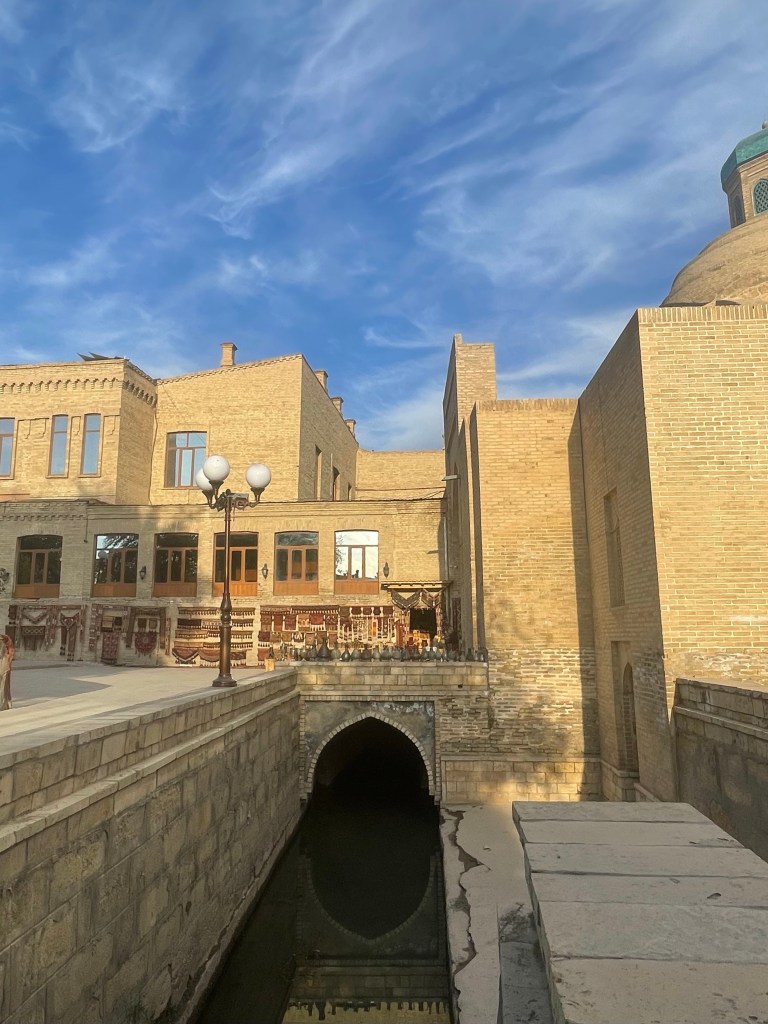

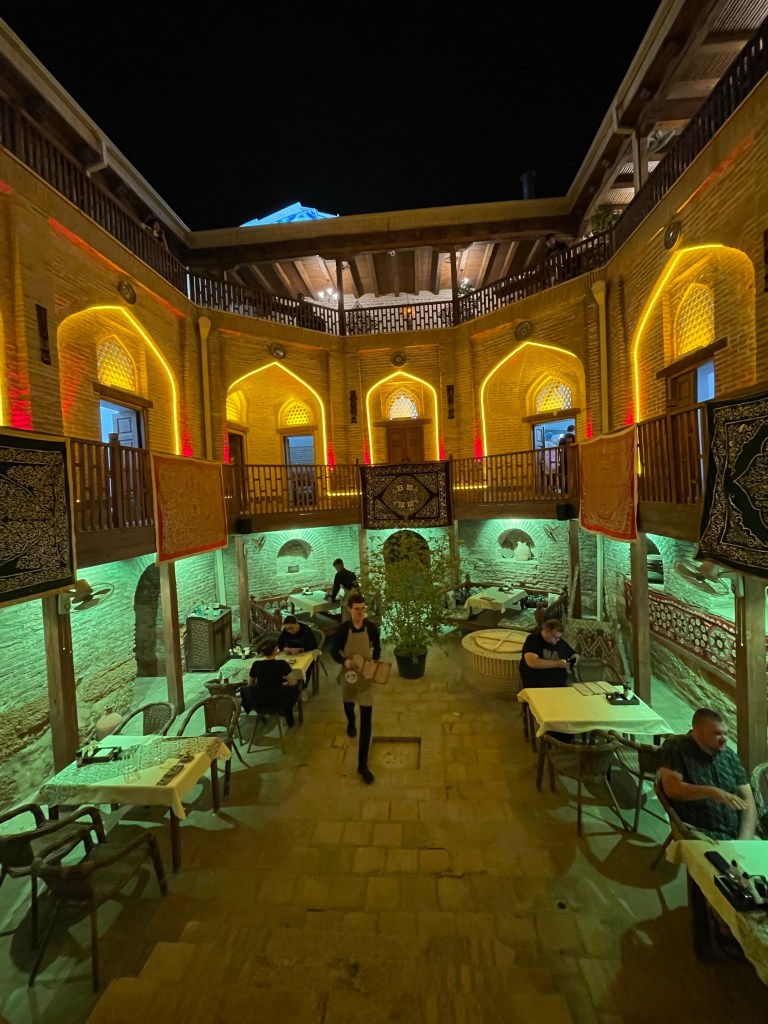
We chose a great part of town to stay right next to the Kalon Minoret complex, which is a highlight of Bukhara. During the day, hundreds of tourists flock to this square to see one of the tallest minarets in the world. We bypassed this square at first to avoid the crowds, and went off in search of dinner. We were lucky and found a cute restaurant that felt quite historical. All around us stone walls rose several levels and in the middle of this round building there was an old traditional well. The food served was very good and nice on our sore stomachs after a bit of food poisoning from a few days prior.

On the way back to our guesthouse we saw that three of the large historical attractions, the Kalon Minaret, Kalyan Mosque, and Mir-i-Arab were all lit up beautifully. It reminded us of the lighting in Samarkand, but on a smaller scale. Since there were still a lot of tourists in the square, we headed back to the guest house and set our alarm for 11 p.m. hoping to come back out a bit later and possibly see the square by ourselves if possible. We lucked out and enjoyed an amazing few minutes in the square with just a few others around before the lights shut off at 11.30pm. We found out the following night that we were very fortunate to come out the night before because they did not come light them up that second night, and supposedly only fully light them for special occasions.


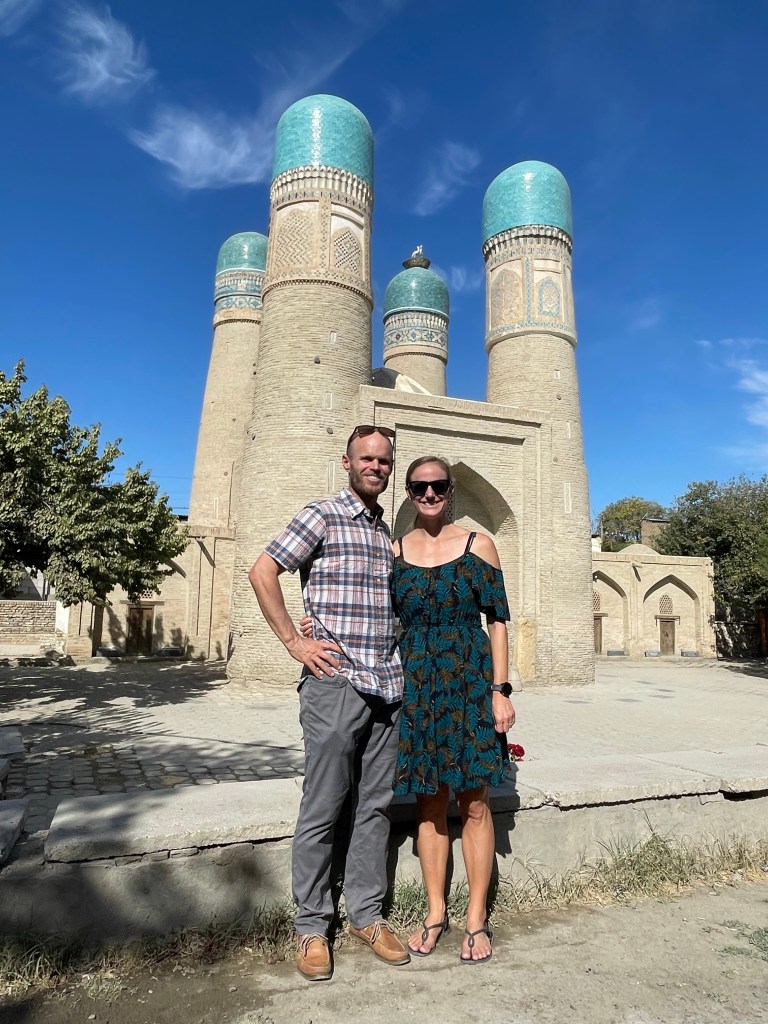
That following day was our main sightseeing day and we enjoyed a long walkabout around town. Our first stop was the small, but famous Chor Minor which is a popular mosque for photographs just outside of the old city. It is quite possibly the smallest two story mosque you will ever see, and is now functioning as a tourist shop. Its size makes it very cute, as well the signature turquoise domes. Next we passed through the old town taking in the old buildings and architecture. We stopped by and had a coffee overlooking one of the original, and only remaining small lakes that were used to bathing and presumably drinking water in ancient times. It was a wonderful place so spend the afternoon, and we finished off the day with sunset drinks overlooking the square.


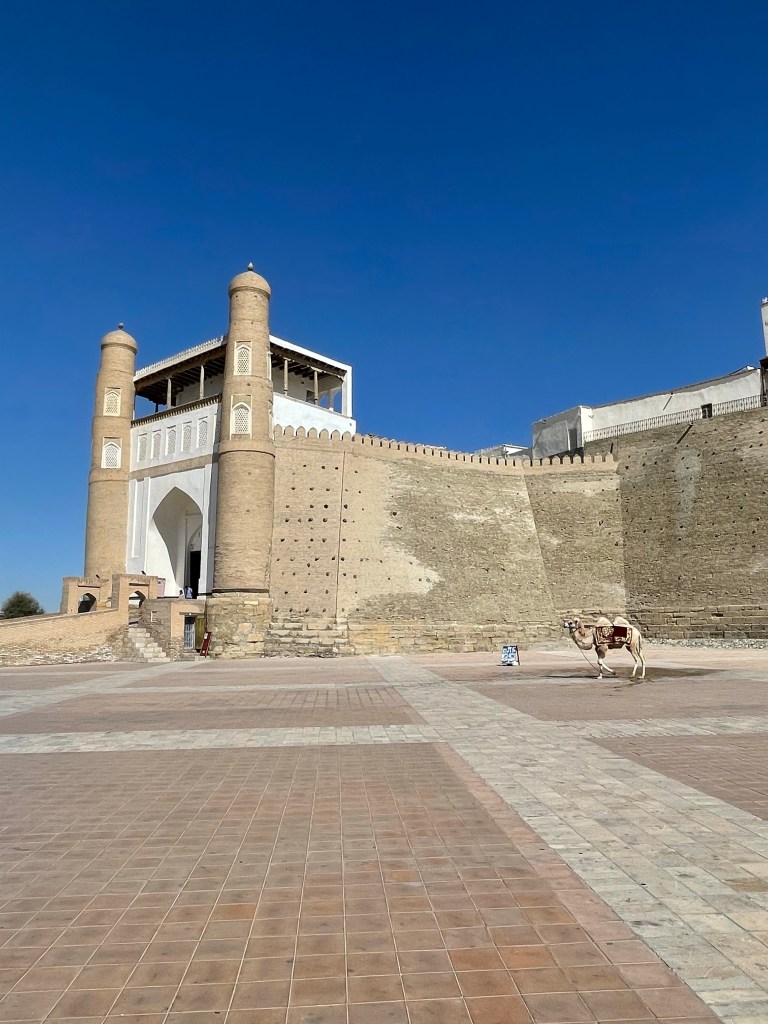
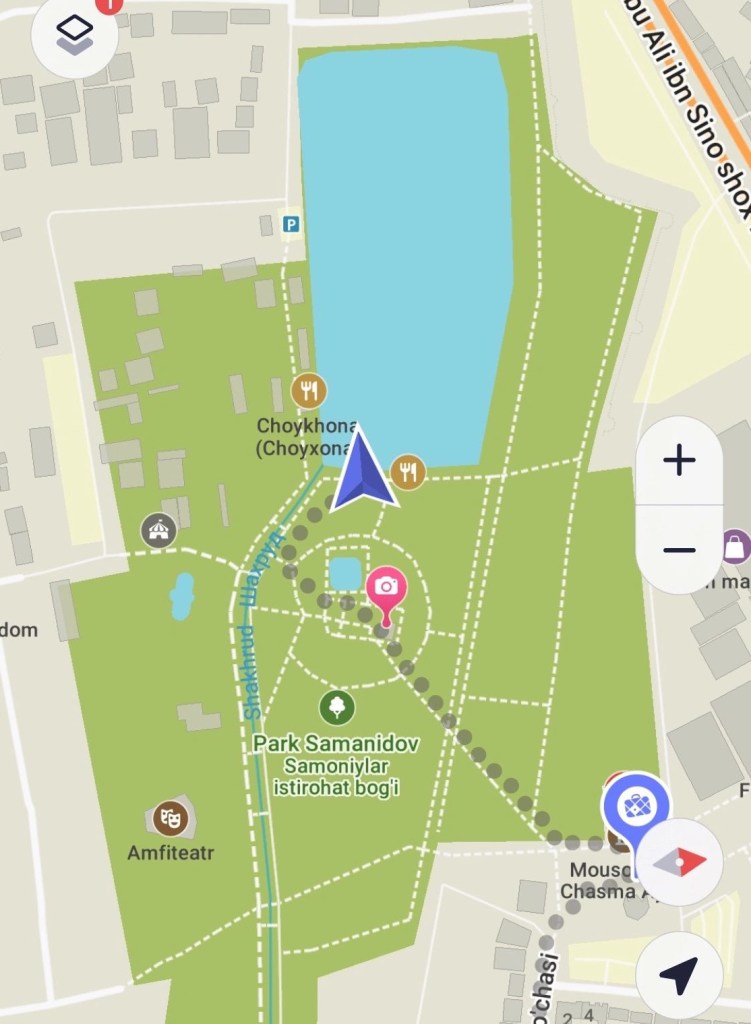
On our last day in Bukhara we set out to see a few more of the historical sights before taking the night train further west. We first stopped to see the fort (Citadel Ark). Most of it has been reconstructed. We took a walk all the way around the large fort walls, but skipped the inside tour as we heard there was nothing special inside. We wandered in the opposite direction from the day before hoping to have a nice lunch at a lakeside restaurant in a park that we saw on our map, unfortunately, when we reached our destination we were met with a rather unkept park and a completely dried up lake. Although disappointed and hungry, we still enjoyed a good laugh at the lake that turned out not to be.

That evening we took our first (but not last!) overnight train journey of our trip. We set out with the objective to reach all the way to the Aral Sea the following day before traversing back east to the ancient town of Khiva by the following night. We are well tested in our travels, however we knew this was a bold one day adventure, and lots of transportation needed to work out in order to make it to Khiva. Our train journey was very pleasant. I splurged and reserved a first class cabin, which meant that it was just the two of us in a room with two single beds and a table. Uzbek railways treats you quite well and provided us with nice sheets and pillows, which made for quite a lovely experience. We alighted the train at the end of the line in the small desert town of Kungrad at around 9 a.m. feeling fresh and ready for the Aral Sea adventure ahead.

Our first task was to change local currency, the Uzbek som that we had pulled from ATM’s the day prior in exchange for USD that we would need for our next stop in Turkmenistan. We found a bank that provided currency exchange, but unfortunately they wouldn’t let us change our Uzbek som without receipts to show where the money came from. Apparently, there is a big problem in Uzbekistan with inflation and the official exchange rate has not matched up with the black market rate, so they have cracked down on currency exchanges and without a receipt from the ATM’s we were out of luck at the bank. Fortunately, the teller told us to sit down and someone would come and help us. A few minutes later a young girl in her early twenties walked in with her dad, and asked us to come with them. The teller indicated they would help us and we left the bank and hopped into their car where they drove us to a different part of town. This all seemed incredibly shady, however the girl spoke good English and their uncle was awaiting us to to sell us the USD that we needed for Turkmenistan. What felt like a super shady back alley deal, actually ended up being great. The girl and her dad even took us to the shared taxi stand where they helped us find a taxi to the Aral Sea.
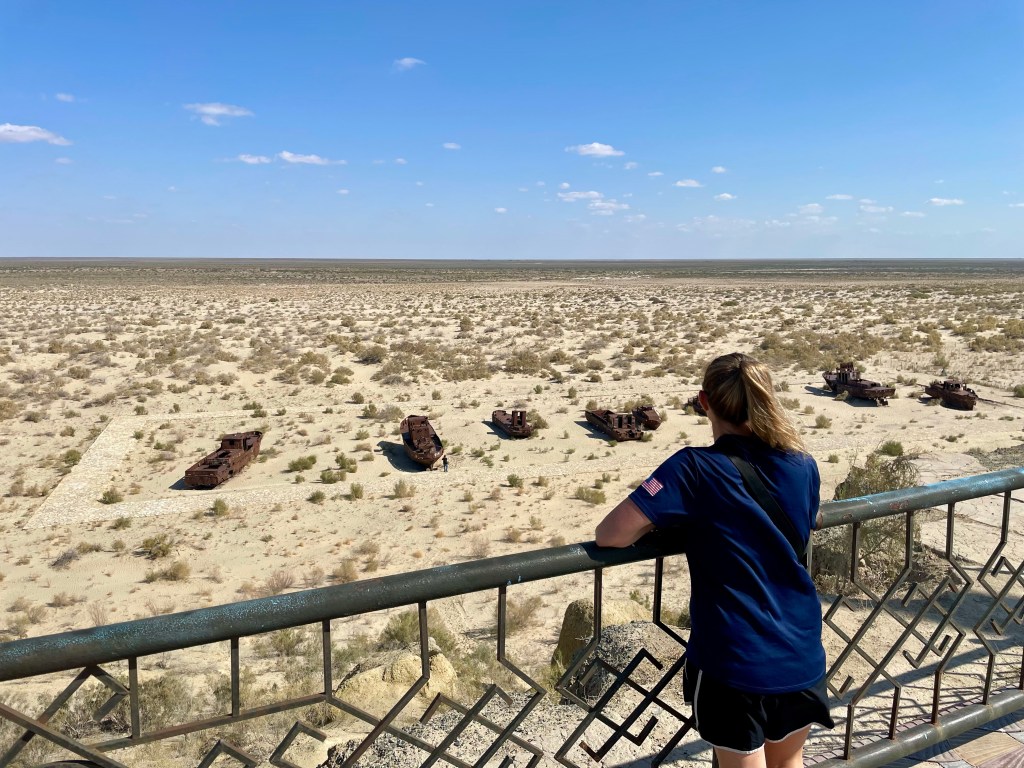
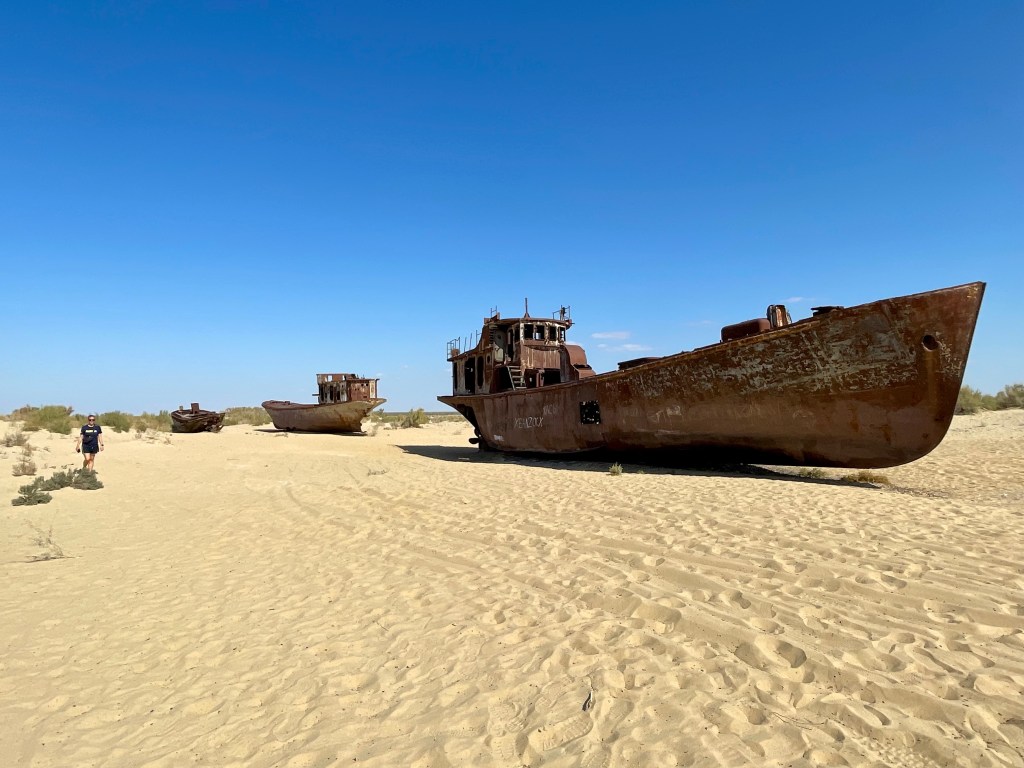
I’ll quickly share a little history about the Aral Sea. When Uzbekistan was part of the Soviet Union the Soviet politicians for some reason decided that this desert region in western Uzbekistan and Kazakhstan would be a great place to grow cotton. The idea was for the Soviet Union to be completely self sufficient, and this was a commodity that they needed to supply a textile industry. Unfortunately for the region, growing cotton requires a lot of water, and the only way to do this in the desert was by diverting water that was coming out of the Pamir, Hindu Kush and Tian Shan mountains and normally feeding into the Aral Sea.

Over time, too much water was being used for cotton production than was being replenished, which meant the Aral Sea began to reduce in size. In 1960, the Aral Sea was the fourth largest lake in the world covering 65,000 square kilometers. By 2010, the sea had reduced to merely 12,000 square kilometers, and with the reduction in size the water became more concentrated with salt, and subsequently the fish all died as well as the huge fishing industry that relied on a healthy habitat. All you see now are skeleton ships in the desert and the remains of a once flourishing fishing town left trying to find its way with no fish.

After seeing the dried up sea and the small accompanying museum we tried to catch a shared taxi to Nukus, hoping from there we could find another to Khiva. This resulted in an eight hour road trip where with four or five different shared taxis before finally arriving in the small ancient town of Khiva at around 10 p.m. that evening. It was a long and at times frustrating day of travel that left us very tired, but I do think that it is important for us to take advantage of the opportunity to see the Aral Sea, and understand the profound impact that humans can have on the environment.

Our final stop in Uzbekistan was Khiva, which was a wonderful surprise as it was one of our favorite places in this country. Similar to Bukhara, Khiva is an old city, and although restored, it has kept its ancient village feel. Unfortunately, we did not have a lot of time to explore since we were joining a tour into Turkmenistan the following day. We walked around the city, looked at some of the old buildings, and had lunch at a terrace restaurant overlooking the famous, colorful, and interesting very short Minaret Kalta Minor. This Minaret is famous since with was built by Mohammed Amin Khan starting in 1851. He allegedly wanted to build a minaret that could be seen all the way from Bukhara. Unfortunately, he died in 1855 and with him, the funding dried up which left a beautifully tiled but somewhat stunted minaret.


Unlike Samarkand where each entrance fee was separate, Khiva bundles all of the entrance fees into one ticket. While this is a great idea in theory, we only had one afternoon to explore and didn’t want to pay the steep price of the ticket. I believe the ticket is good for 2 days and if in Khiva longer than an afternoon it is totally worth it. We had heard a lot about the beauty of the Juma Mosque, which is a bigger version than the one we visited in Kokand. This one has hundreds of giant wooden beams. Since the entrance was unmanned we decided to walk right in and no one stopped us.

We saw the sun was setting and so we wanted to take advantage and stumbled upon a rooftop bar attached to a hotel. We got a couple of beers and enjoyed our sunset views over Khiva. After drinks, we headed out of the old city to a local restaurant we were told about on the other side of town. As we exited the gates we found the sky had turned radiant colors and of course, we took pictures and enjoyed the view. After dinner, we were able to walk back through the city when it was lit up and night and it was a sight to behold.


The following morning we woke up early and took a run through the city to see it quiet and void of tourists. It was nice to get in a run because we haven’t had much time for exercise aside from hiking and walking this trip. To run and see the sights at the same time was just the perfect way to end our journey in Uzbekistan. Finally, we arranged a taxi ride to the nearby border crossing where we met our tour into Turkmenistan.


 Teri and Nate's World Adventures