After a disastrous travel day (or two, which does not need to be remembered in this blog…or ever) from Bandhavgarh Tiger Reserve in India to Pokhara, Nepal we were finally excited to start our Nepalese hiking adventures. We secured visas on arrival in Kathmandu for thirty days and we planned to take advantage of every single one of the days. With thirty days in Nepal, our trekking schedule had us hiking in the Himalayas for twenty of them!
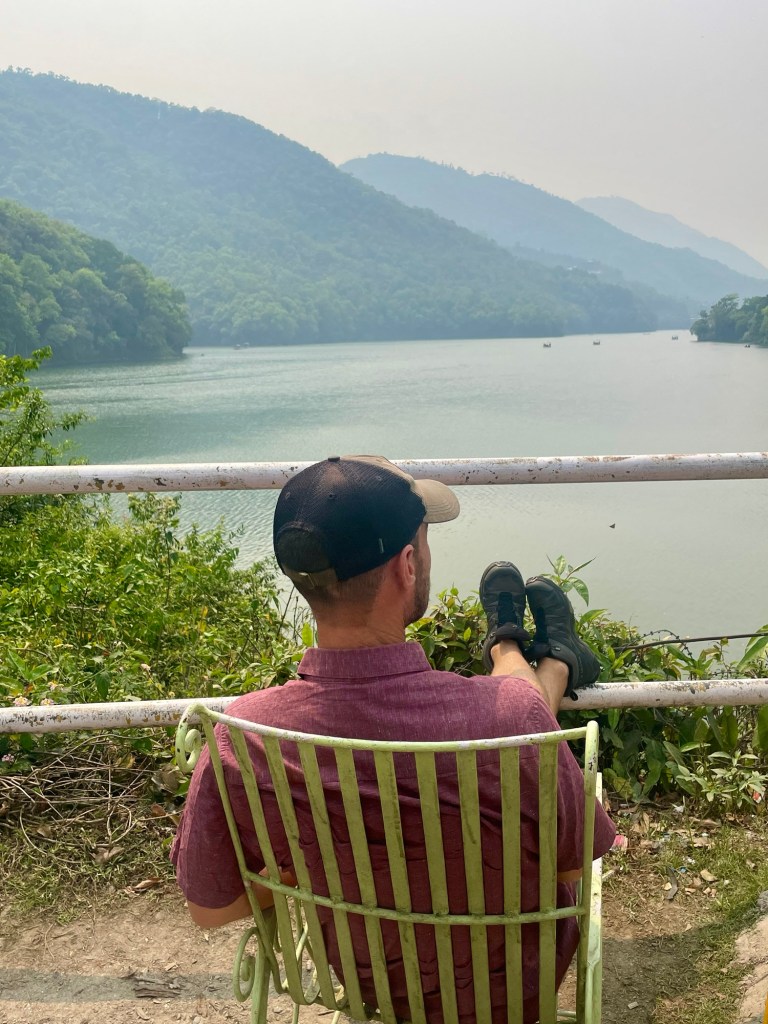
We were pleasantly surprised by the small city of Pokhara, which sits along the shore of a large mountain lake. We stayed at the Hotel Silver Oaks Inn, which has lovely spacious rooms, a cute golden retriever in the lobby to greet you, and even a buffet breakfast for only $22 USD per night. Our first order of business was to apply and acquire the necessary hiking permits for the Annapurna Base Camp trek (ABC). This was the most stressful part of our travel to Nepal since the permit office is not open on Saturdays. We originally were scheduled for a Thursday evening arrival in Pokhara, however, travel delays cost us a day, and we would have had to change our Annapurna trekking plans if we were not able to sort out the permits by that Friday afternoon.
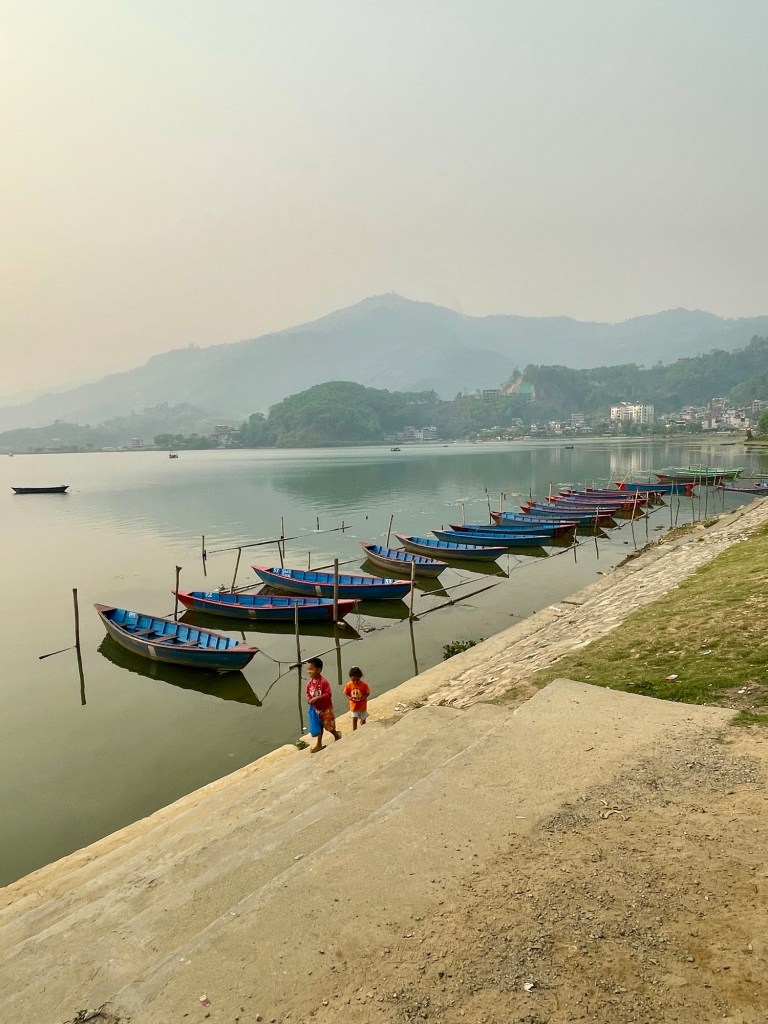
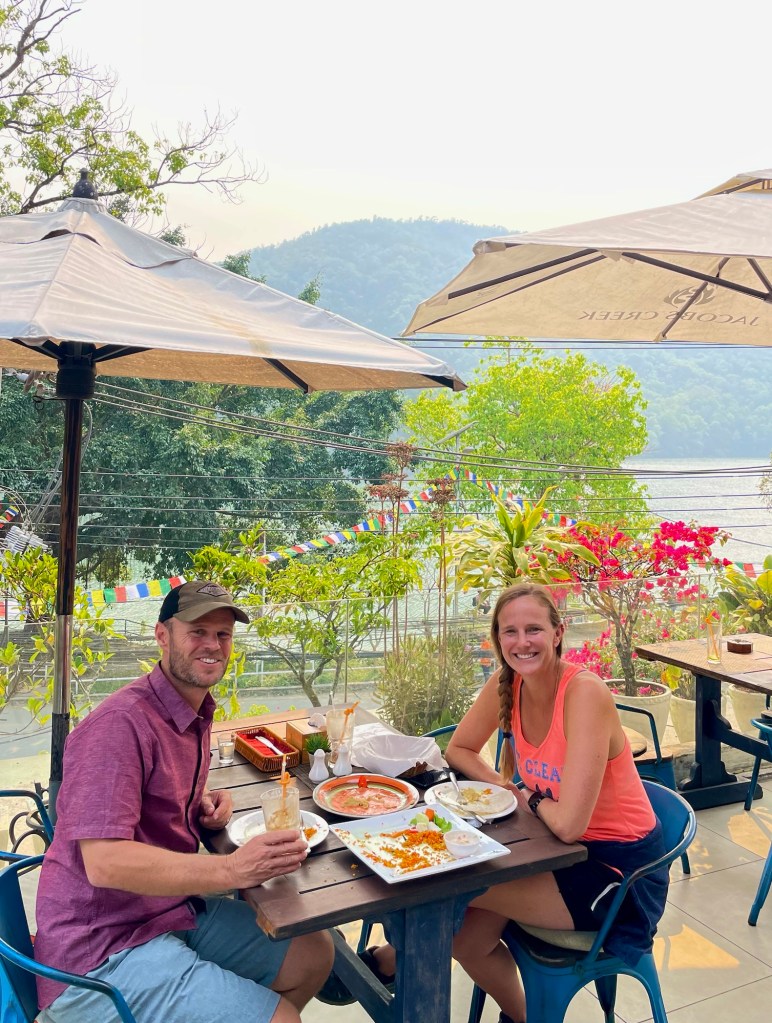
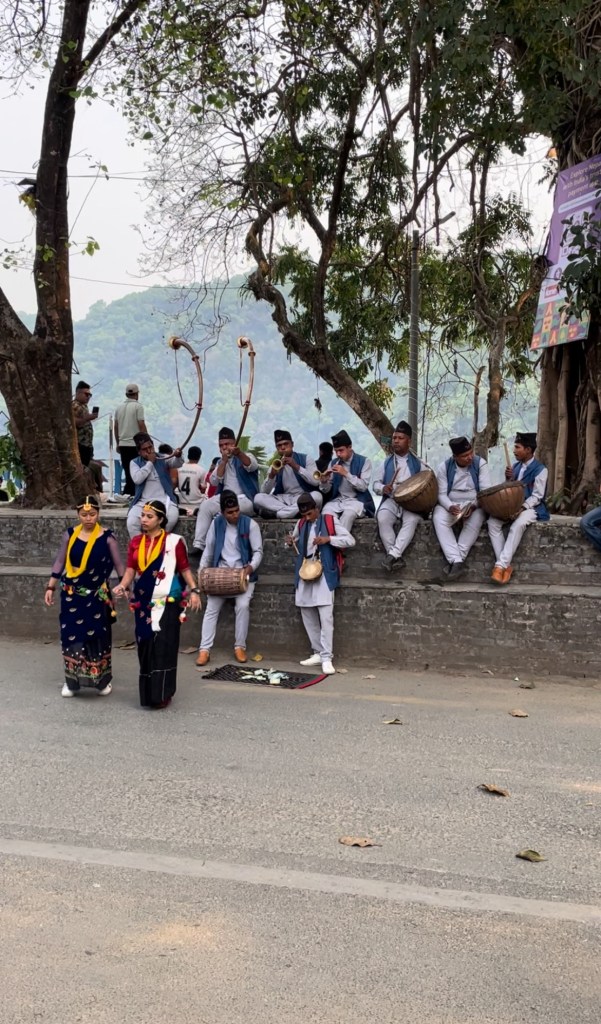
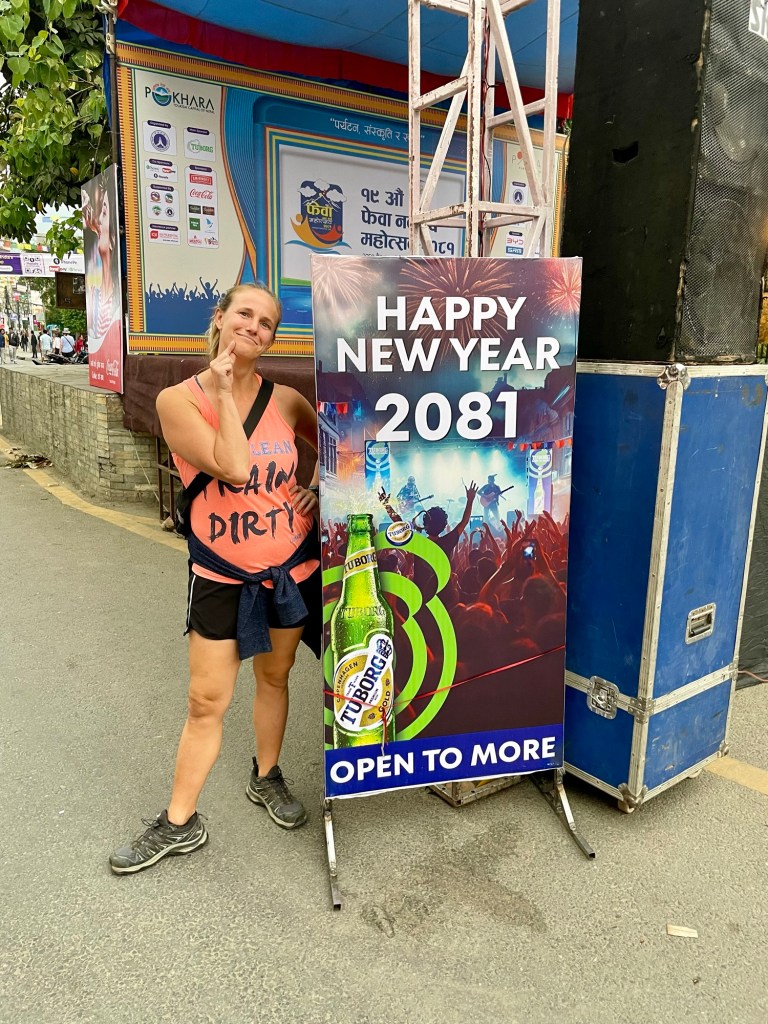
After securing the permits and breathing a sigh of relief, we decided to walk down to the lakeside to take in the tourist sites and have a late lunch. As we were walking, we found it odd that there were no cars on the main road by the lake, and we quickly found out that the streets had been closed since it happened to be the Nepali New Year’s Eve. To our great surprise, according to the Nepali Calendar, we are currently in the year 2081! It was exciting to be there on a holiday since big groups of musicians were dancing up and down the street playing their traditional instruments. Many locals took the tactics of setting up blankets, sitting down in community circles while playing traditional music, and drawing in friends and other locals to celebrate with them. It was a lively spirit all day long, which led into the evening when they brought out a stage and had local performers dance.
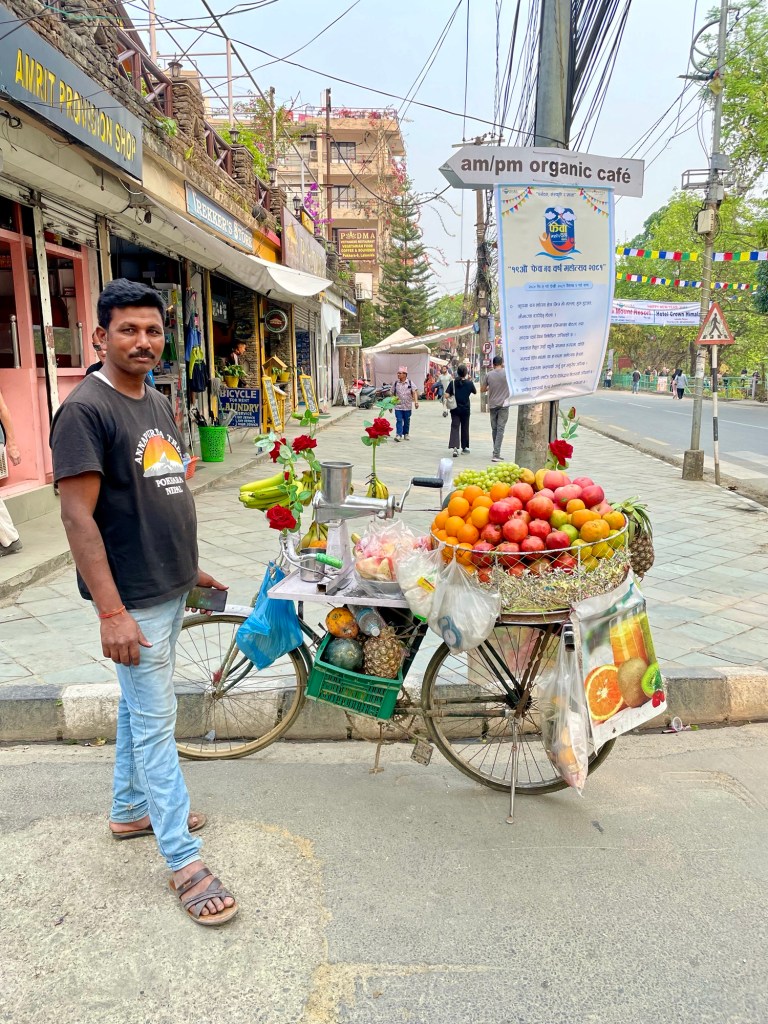
The streets along the lake in Pokhara are full of shops, bars, and restaurants. We enjoyed walking along and seeing the wares of all the local vendors. I really wanted to buy everything and had to exercise some shopping restraint since we had little room in our backpacks for souvenirs. We bought a couple of small things for our hike and rented some sleeping bags, but that was all. Through Instagram, I found that my friend Maureen from my Gaelic team in Kuala Lumpur had just finished up the ABC hike that we were set to begin. We met up with her for dinner that evening and picked her brain about everything we might need to know before commencing.
The following morning, we enjoyed a bit of a sleep-in as we were in no great rush. We packed our stuff, had a leisurely breakfast, and walked around town a bit more. In the early afternoon, we took our backpacks and headed to the local bus stand to catch a bus to the village of Ghandruk. This small mountain town would be the starting point for our hike. We had read that Ghandruk boasted great views of Annapurna and is a great starting point. Local buses (or really any form of transport) are very slow in Nepal and it took much longer than expected to get there.
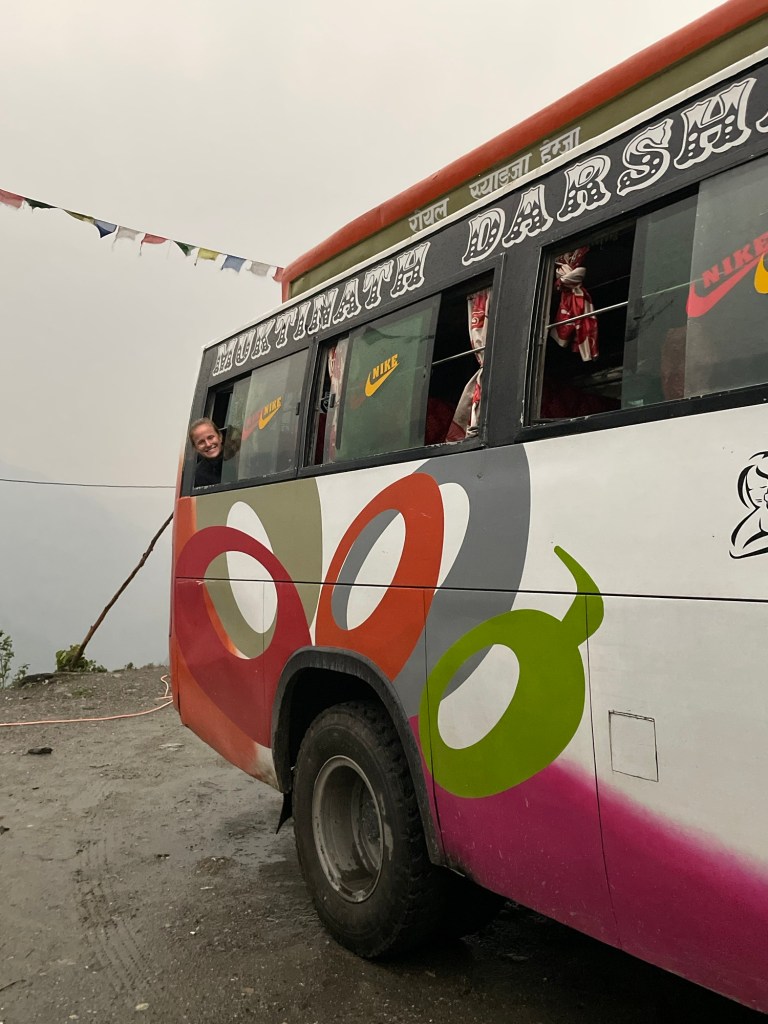
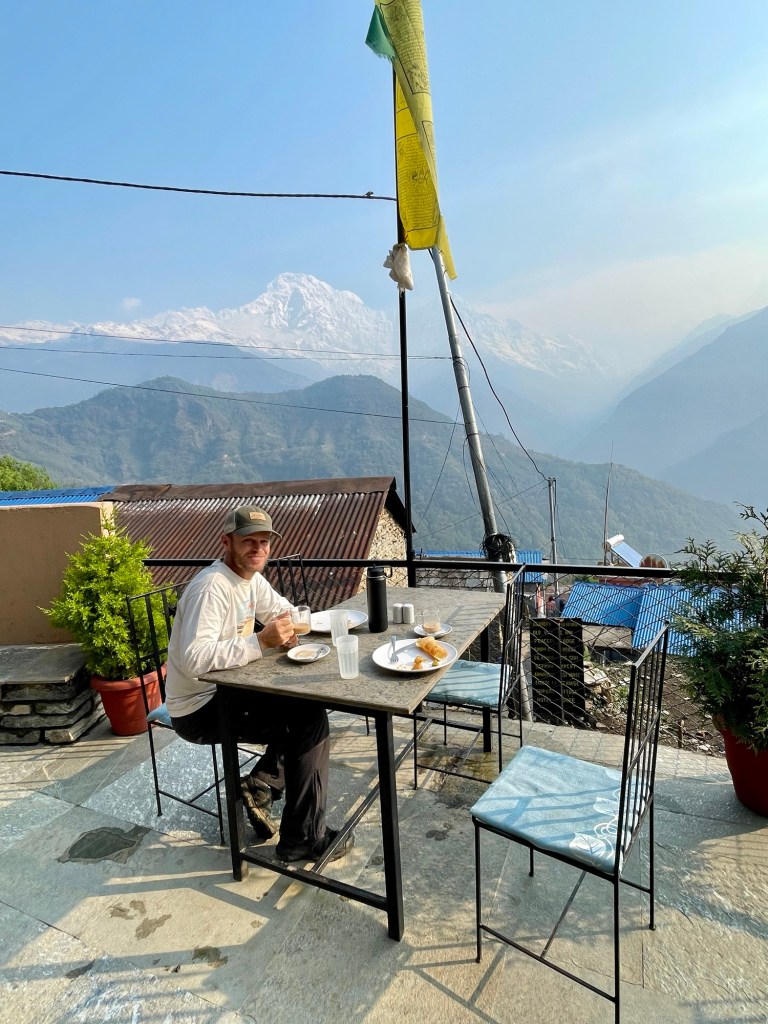
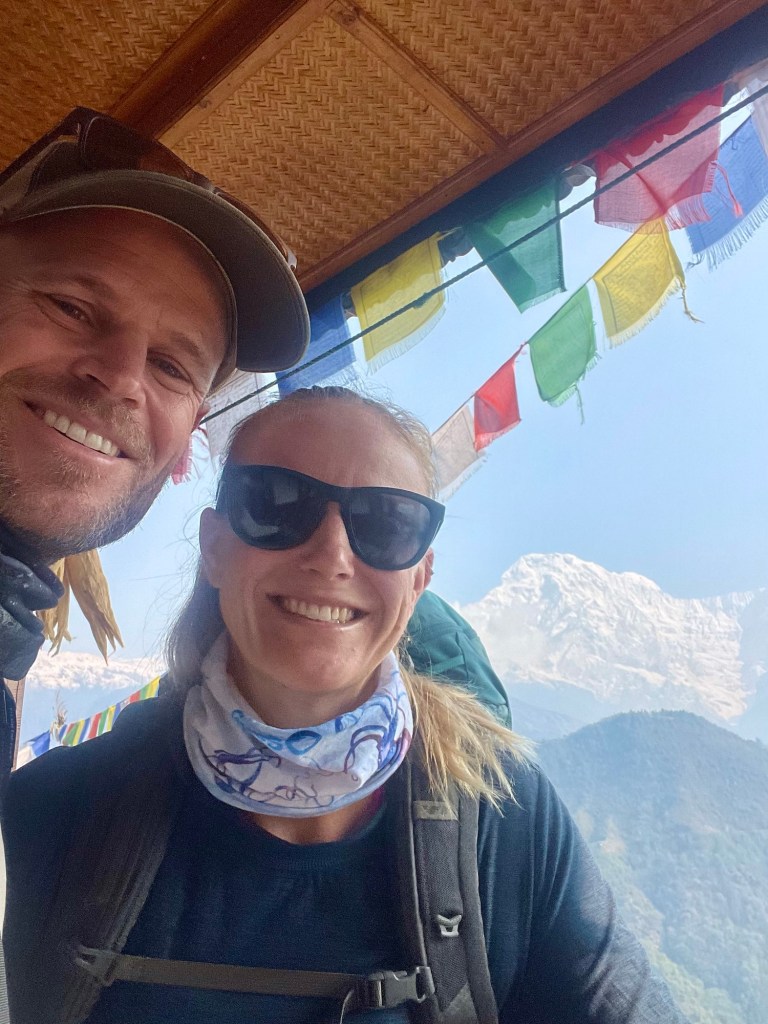
We arrived in the rain just as the sun was setting and we were still looking for a place to stay as these mountain guesthouses don’t return messages or seem to take reservations. We lucked out and found the Hotel Rodhee, which had comfortable rooms and hot showers. The view of the mountains in the morning was just as spectacular as we imagined. With the long travels and rain from the night before now behind us, we woke up very excited to head into some of the tallest mountains in the world that now stood dauntingly before us.
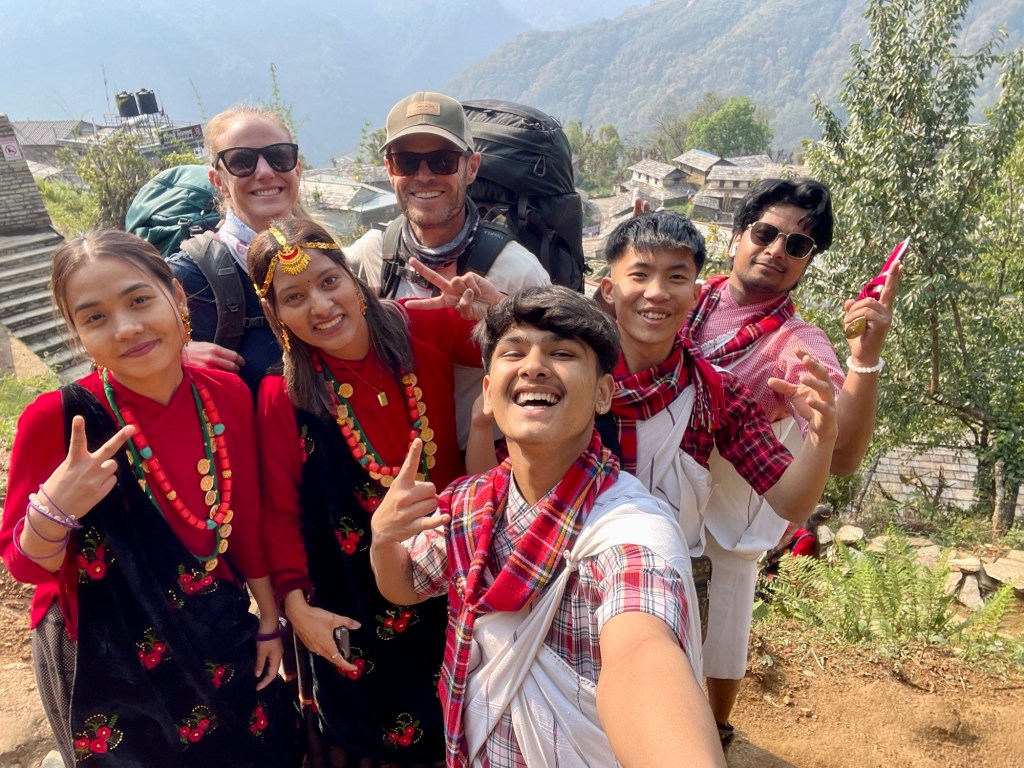
We decided to hike the ABC trek without a guide or a porter. Technically this is not allowed in Nepal, but with our past trekking experience it was not a problem, and no one ever questioned our decision. This said, I would suggest always having a hiking buddy and I had the best one in Nate. Our day started by winding our way through Ghandruk. We discovered this is a popular tourist destination for many local Nepalese who might not be up to or interested in hiking higher. They come to this highest village located at the end of the road into the mountains, rent traditional Tibetan clothing, take pictures, and dance with the Annapurna range overlooking. It seemed like a fun activity, and we saw many families dressed up in the same traditional clothes and taking pictures.
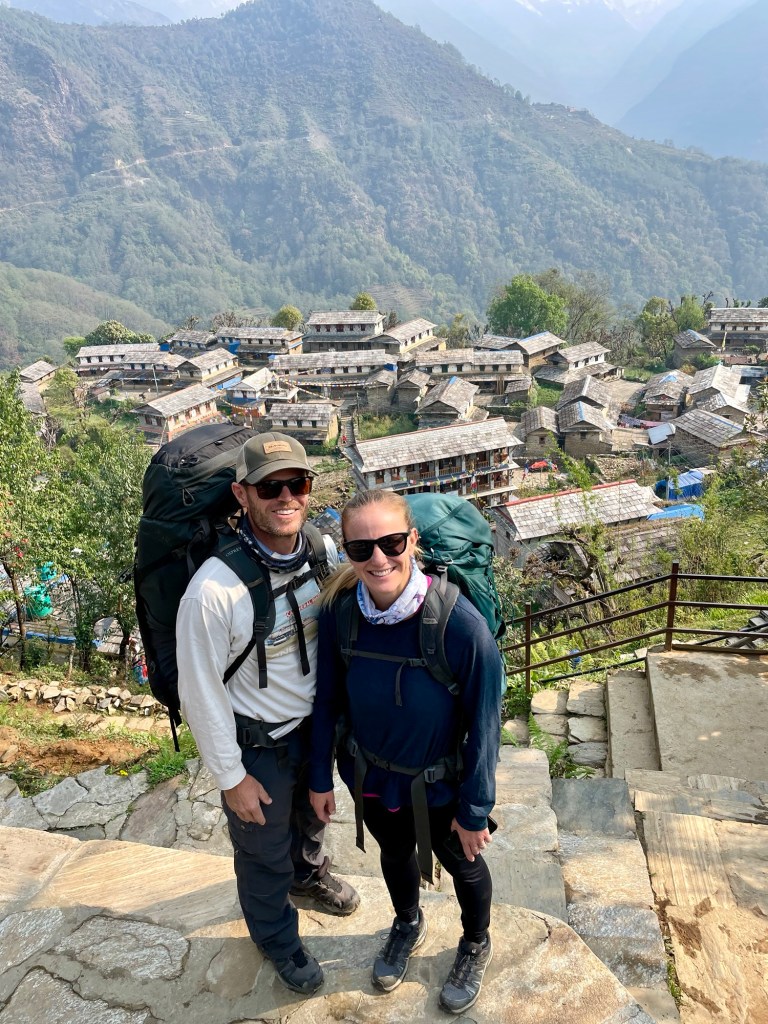
We began hiking out of the village and moved quickly up around 500 meters to the pass where we began to take in even better mountain views, particularly of Machapuchare, which we would see many times throughout our hike and in my opinion turned out to be the most impressive mountain in this range. After the steep climb, we gave everything we gained back as we had to hike straight back down into the valley 600 meters and thus the theme of the day had begun. After hiking down and crossing the river, we again had to hike up 600 meters of stairs to reach the next village of Chhomrong. Here we stopped for a much-deserved lunch at the International Guesthouse, which typically provides great views of Annapurna above, but was obstructed by clouds and smog on this day. The owner said we needed to return in October for the clearest skies.

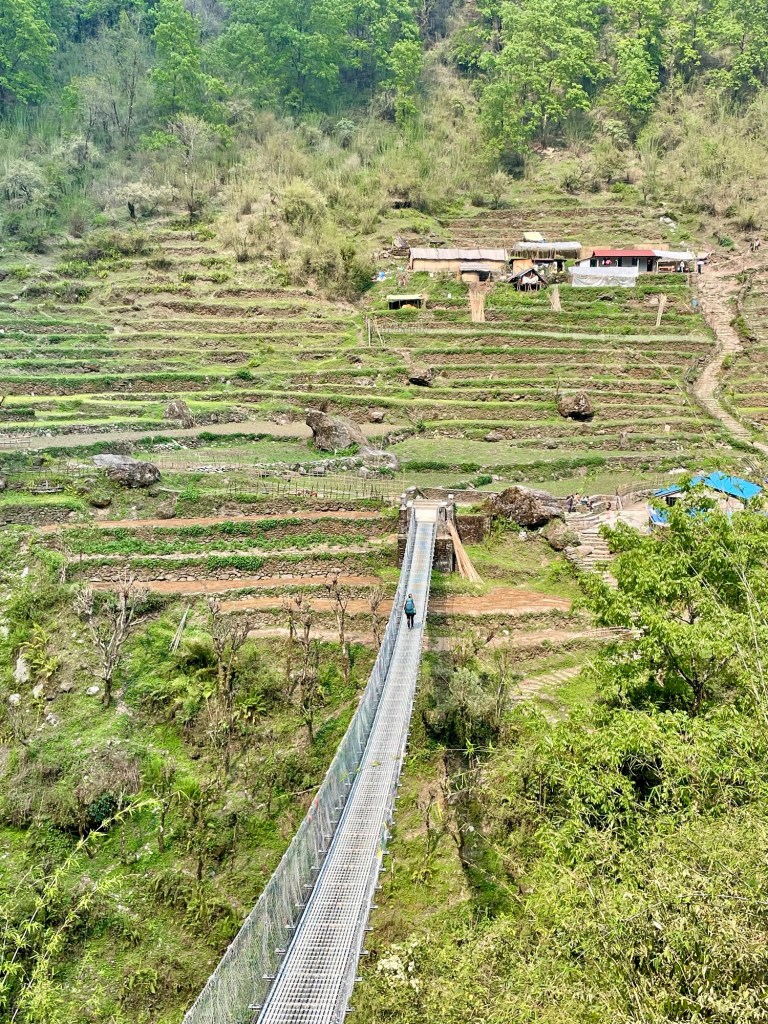
From Chhomrong we headed…you guessed it, back down 500 meters of stairs into the valley where we passed a National Park checkpoint and had to show our park passes on the way down to the river crossing below. We then crossed a long suspension bridge and started back up for our final steep push of the day. By this time it was starting to get a bit late, and our legs were shaking after the literal thousands of stairs we had hiked while carrying full packs at altitude. It was an extremely tiring first day, but it was a great start to our Everest training. We finished the day in Upper Sinuwa at the Sinuwa Guesthouse taking advantage of the free freezing cold shower. At the finish of this day, we estimated that we hiked around 1800 meters up, 1200 meters down, and over fifteen total kilometers, which is a big day at altitude.

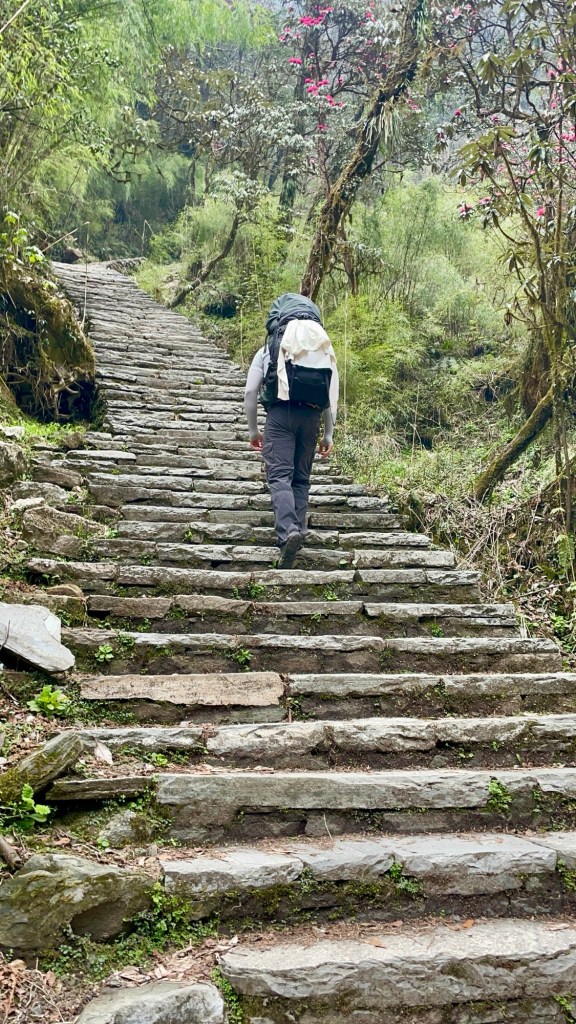
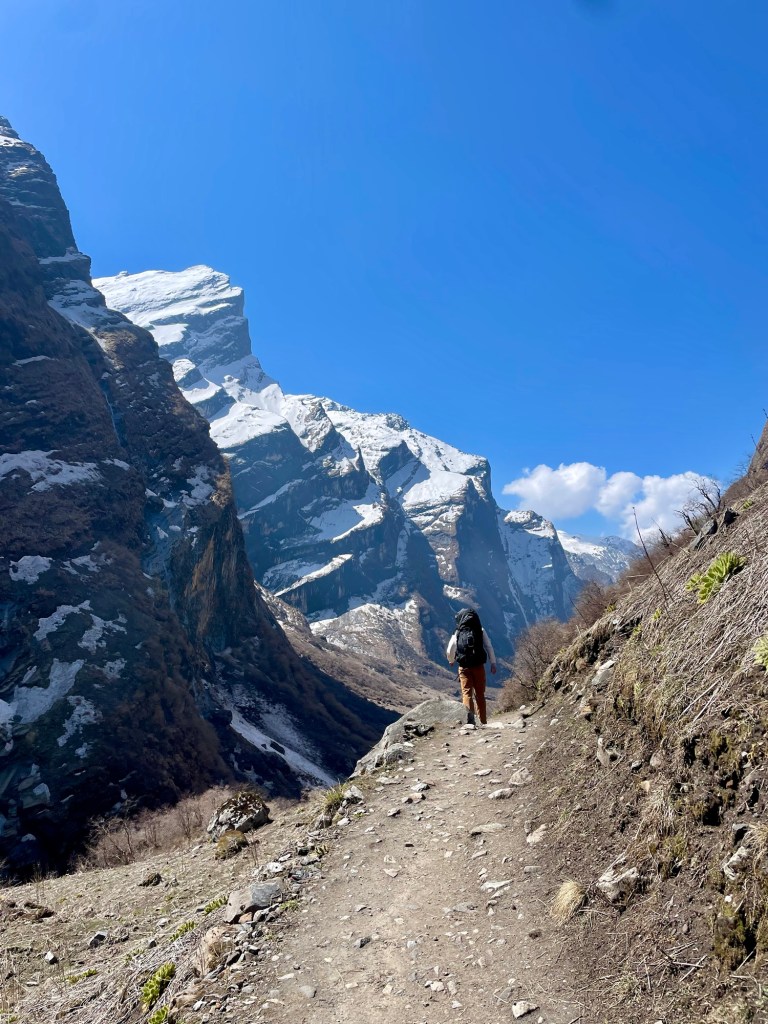
The following morning we continued up the mountain. My calves were so sore from the marathon day prior, but we were excited to get deeper into the mountains. Most of our walk was through a beautiful forest, and we were shaded from the sun. After hiking for around an hour, we reached the village of Bamboo. Shortly after, we were joined by a friendly dog who would hike the rest of the day with us. She did not want to be touched, but she waited for us before she continued hiking. We also saw a pack of langur monkeys in the trees, which was a surprise at these altitudes, and we stopped to watch them for a while.


Between the village of Dovan and Himalaya, we found another surprise. There is a religious pagoda backed by a cliff wall full of waterfalls and trees with pink flowers everywhere. It was truly a breathtaking place. One final push uphill and we reached the village of Himalaya for lunch.

Himalaya was our favorite place to stop for two reasons. First, they had a real coffee machine! Second, there is a restaurant with a big patio to eat outside with stunning mountain views. We stopped here for lunch on both the way up and then again on our way back down.

After lunch, we had our final push to our tea house for the third night. It is known on the trail that the stretch between Himalaya and Deurali is the toughest stretch of the trail since it is very steep, and unlike the rest of the trail, it is not as well built with a lot of rocks to scramble up. We were greeted at the top with huge cascading waterfalls on nearly every cliff. We stayed at the Shangrila Guest House in Deurali, which was surprisingly very quiet with only a couple of people at our lodge for the night. We made great time this day as it only took us four and a half hours of hiking to cover just under twelve kilometers with 1,000 meters in elevation gain.
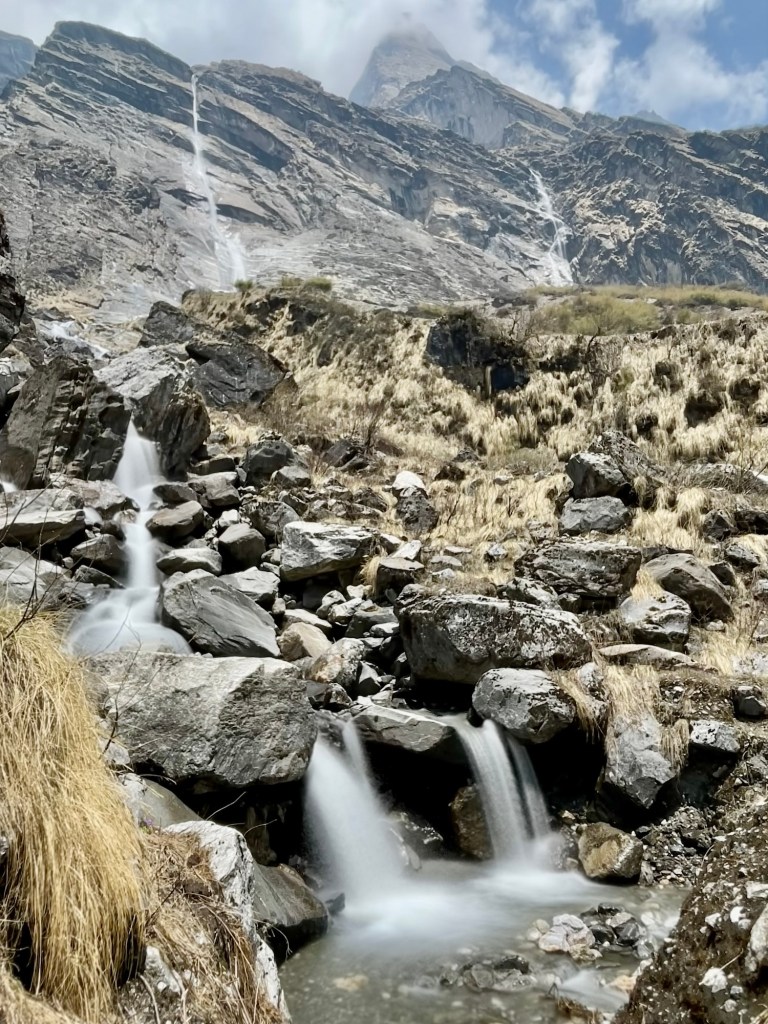
The next day we started early as we were excited for our final push to the Annapurna Base Camp, which turned out to be a wise decision with rain and snow coming in later in the day. We had another 1,000 meters to gain in elevation in order to reach our top elevation of 4,130 meters (13,550 feet), but this is a steep stretch as it only covers 8 kilometers of total hiking. We were initially worried because we heard that you may need crampons, but we found the snow-covered trail near the top to be relatively flat and for us, crampons were not necessary.
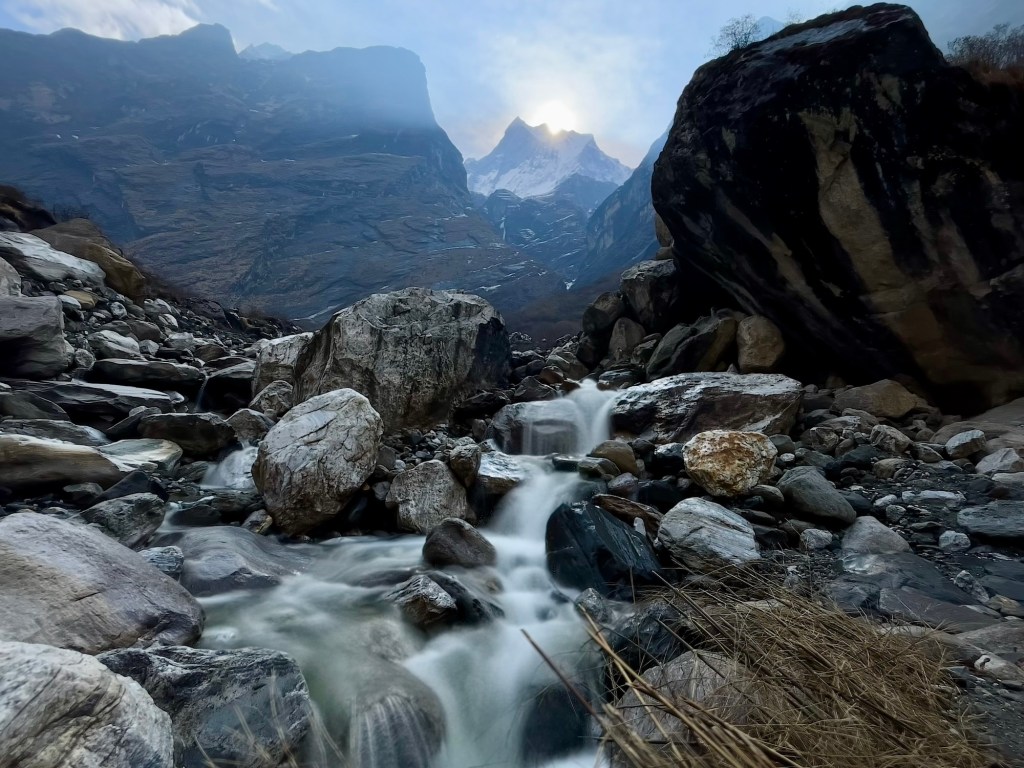
The steepest push was early in the day from Deurali to Machapuchre Base Camp. This was another impressive little village with an amazing view sitting at the base of Mt. Machapuchre, which in my opinion is the most beautiful mountain up there. At just under 7,000 meters it is not nearly as high as Annapurna, however, it is so technical that no one has ever successfully climbed to the top. It is noteworthy that Annapurna is also extremely technical, considered the most technical of the 8,000-meter peaks, and more deadly than even the infamous K2.
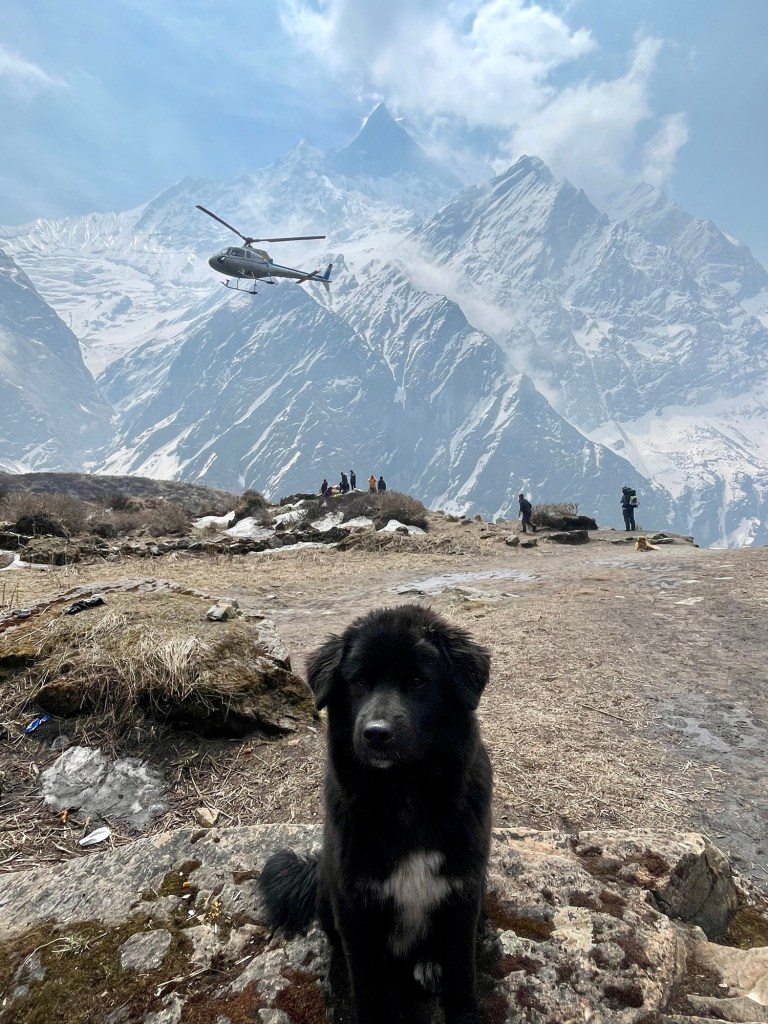
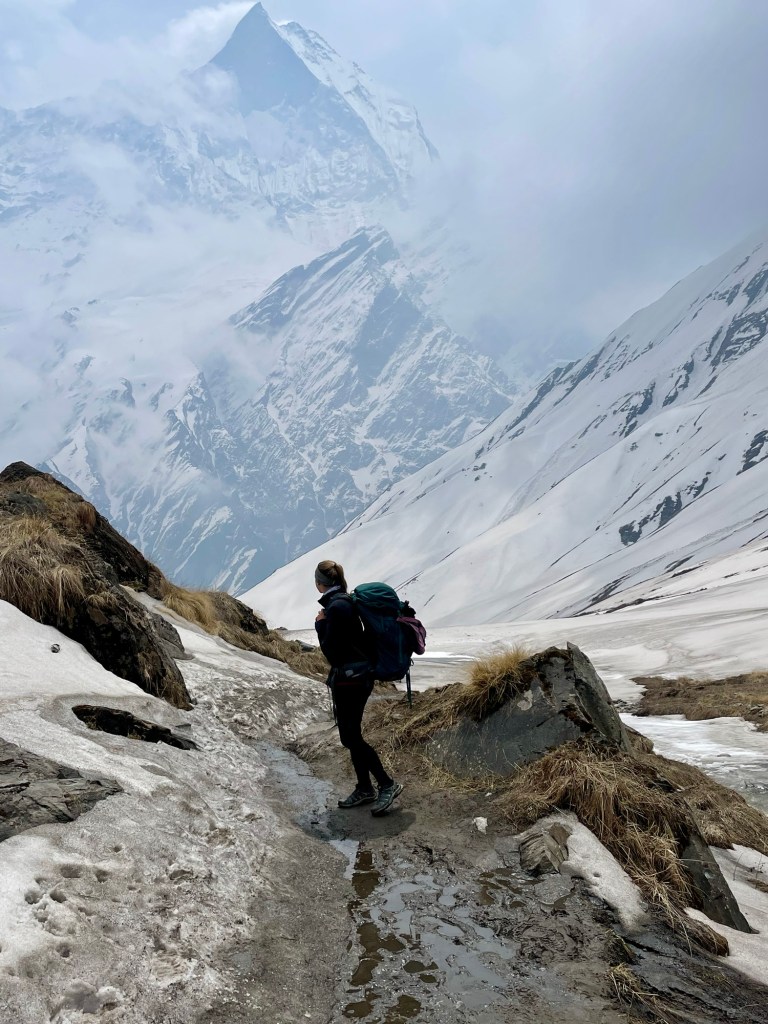
From there, we turned the corner toward Annapurna where the snow-covered trail began, luckily from here it was just a gradual push up the final 500 meters to the top. Again, if you have walked across the snow before and are comfortable with that feeling, we felt that there was no reason to bring along crampons. We hiked up a tight valley with huge snow-covered mountains on all sides of us. We could see evidence of old rock slides and avalanches that skirted along the left side of a large glacial valley. Both the scenery and the altitude took our breath away. As we reached the top, we could see both Annapurna South and the 8,000-meter Annapurna I ahead, but they were slowly getting clouded in and by the time we reached the top we could only see the very top of the peak.
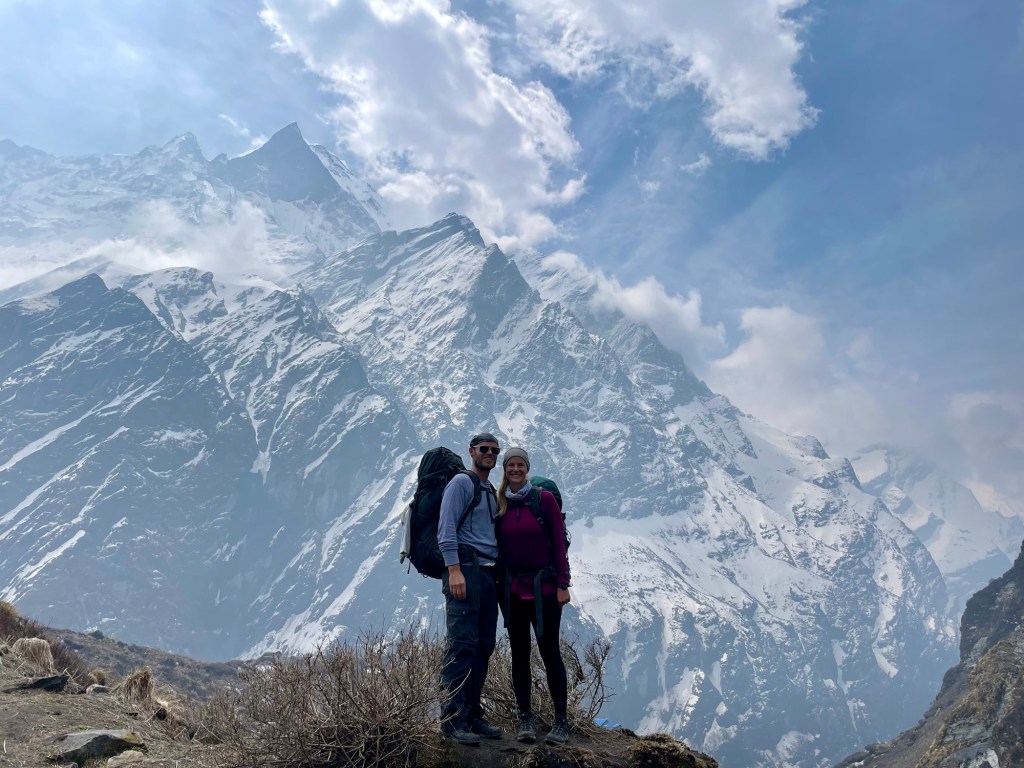
We found a guesthouse in the village and hung out in the common room all afternoon with a big thermos of honey, lemon, and ginger tea taking in the warmth from the kitchen since fireplaces are not allowed in the Annapurna National Park. We looked out the giant windows that surrounded the dining hall and were able to see the final late-day sunshine on Machapuchre before it disappeared in a snow and hail storm. This guesthouse was our most crowded and a group of twenty Chinese hikers showed up during the storm. Due to the crowds of hikers this evening they asked us to share our four-bed room with two Bangladeshi trekkers who were really struggling with the altitude. I think it was more psychological, but I did not sleep well at all that night, and my heart was beating so fast. This is the first time I have felt signs of altitude sickness and it made me worried about our upcoming Everest Base Camp and Three Passes trek.
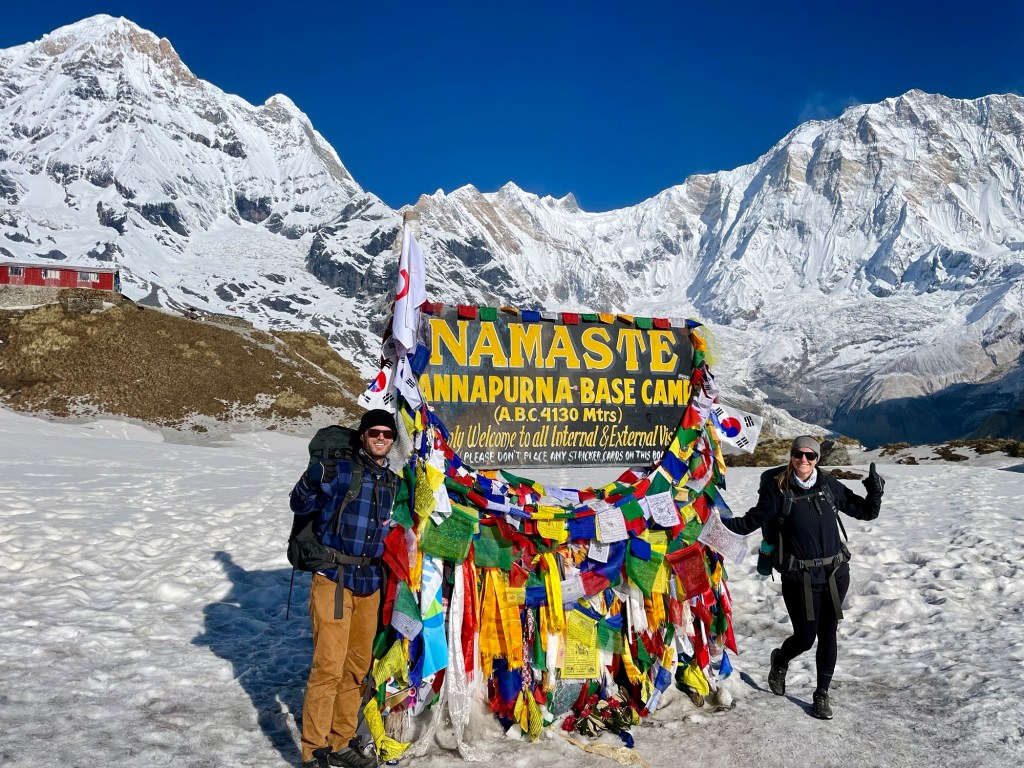
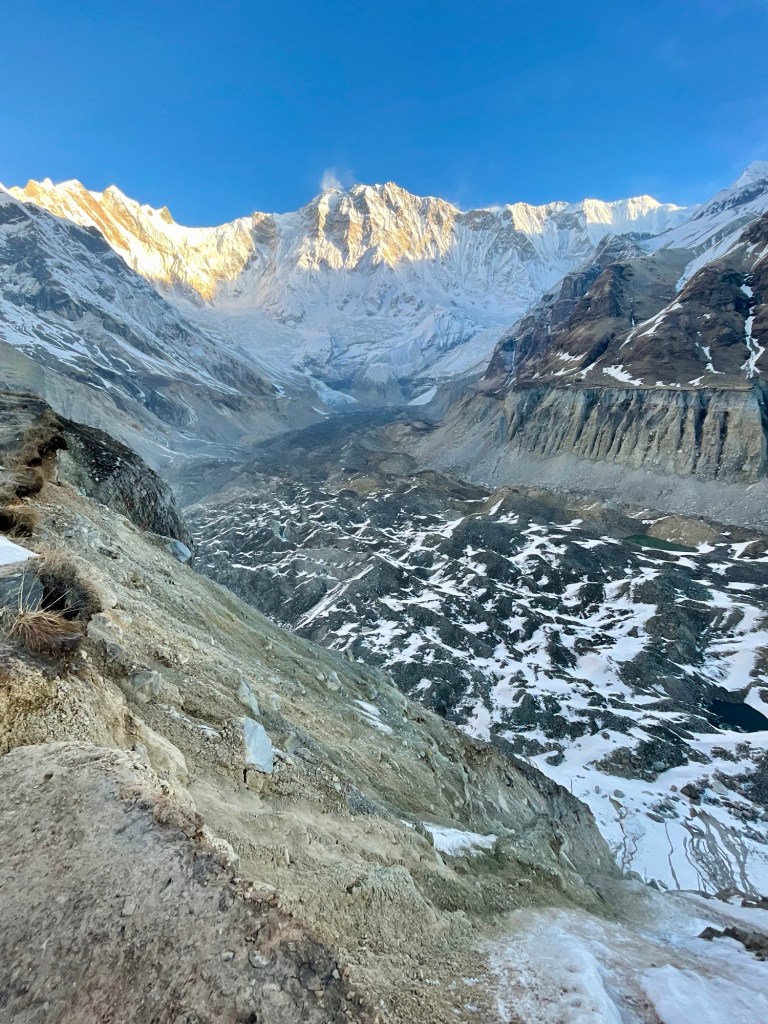
The following morning brought a complete turnaround in the weather with sunshine and blue skies greeting us to start the day. You could not have asked for a more beautiful day to spend high up in the Himalayas. The entire Annapurna range was shining in full glory as the sun crested over Annapurna, and we woke up early to take pictures with the morning light seemingly perfect for photographs. We took so many pictures and stood there quietly feeling so small amongst these giant peaks.


The rest of the day was spent descending down that we climbed up for the two days prior. Our goal was to get back to our first camp at the village of Upper Sinuwa. We had lunch at our favorite coffee shop in the small village of Himalaya and took in our final views of the giant peaks above. That day we hiked just over nineteen kilometers over seven hours. It was far easier trekking back down at these high altitudes, however, our thighs were still very sore and shaking after countless steps down with our full packs.
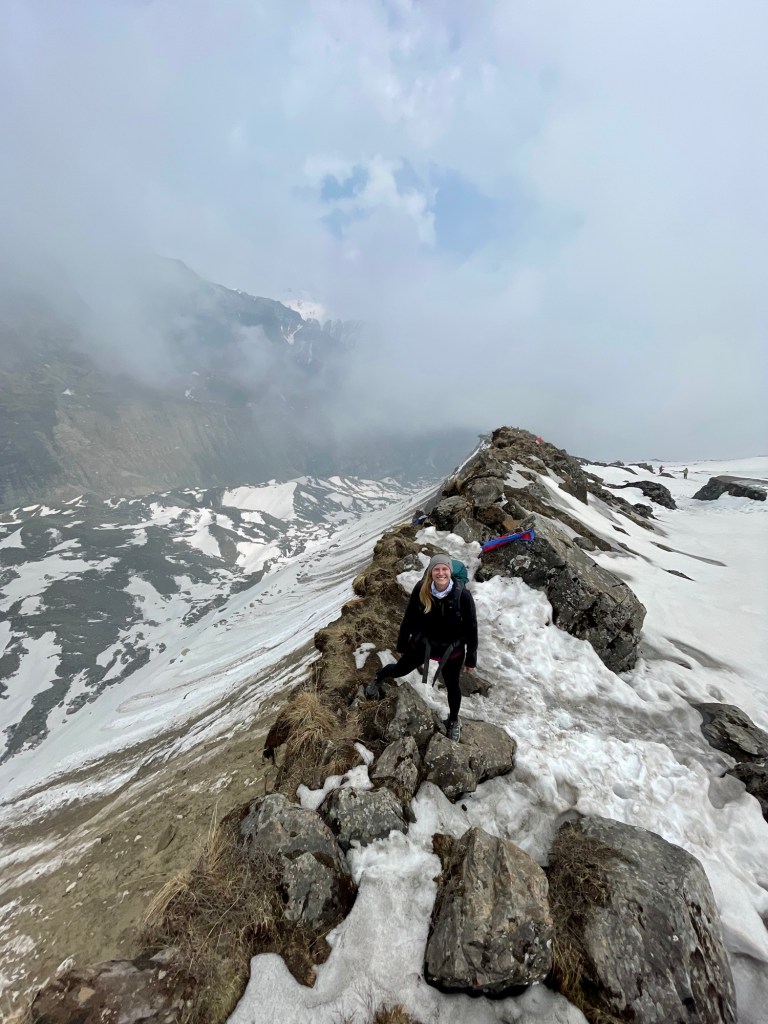
The final day of trekking was supposed to be a fairly easy day, but trekking in Nepal is always unpredictable and it turned out to be a much longer hike than we planned. We woke up in Upper Sinuwa and decided to wait for breakfast until the next village of Chhomrong in order to get an early start on the trail. We hiked the remaining steps down into the valley backtracking what we did the first day, crossing a suspension bridge and then we had to hike all the way back up to the tea house in Chhomrong for breakfast. To make it more interesting we counted all the stairs and discovered we went up 2,240 stairs to the top. We had breakfast at the International Guesthouse where we ate the first day of the ascent and then descended the mountain on the other side to get to our final stop, and one we were very much looking forward to, the Jhinu Hot Springs.

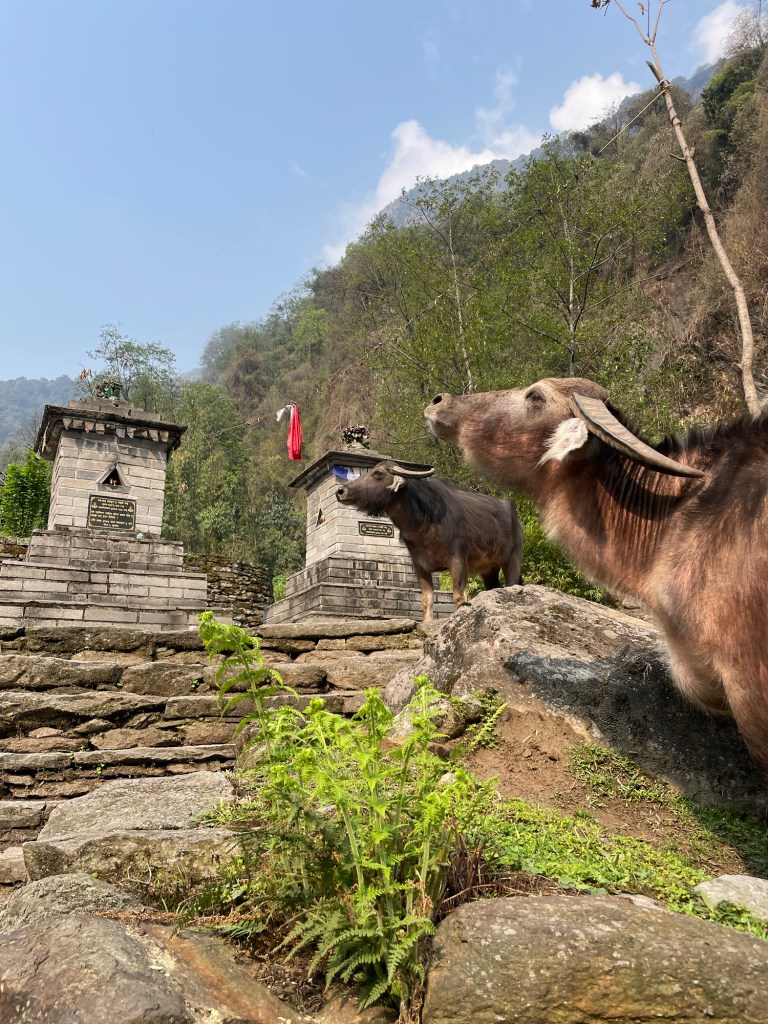
This was an extremely steep climb down, and the more typical way in which people start the ABC hike if they are not starting from the village of Ghandruk as we did. At this point, we were running down the stairs because that seemed to put less pressure on our already sore quads. After paying a small fee for the springs, we descended all the way to the river where we found four hot pools next to a beautiful river. They were really nice pools, but we found they were doing work to protect them from washouts that must occur in the spring runoff, and it was subsequently a bit of a construction site that blocked the river views from the pools themselves. Nonetheless, the water was warm and it was amazing on our sore muscles.
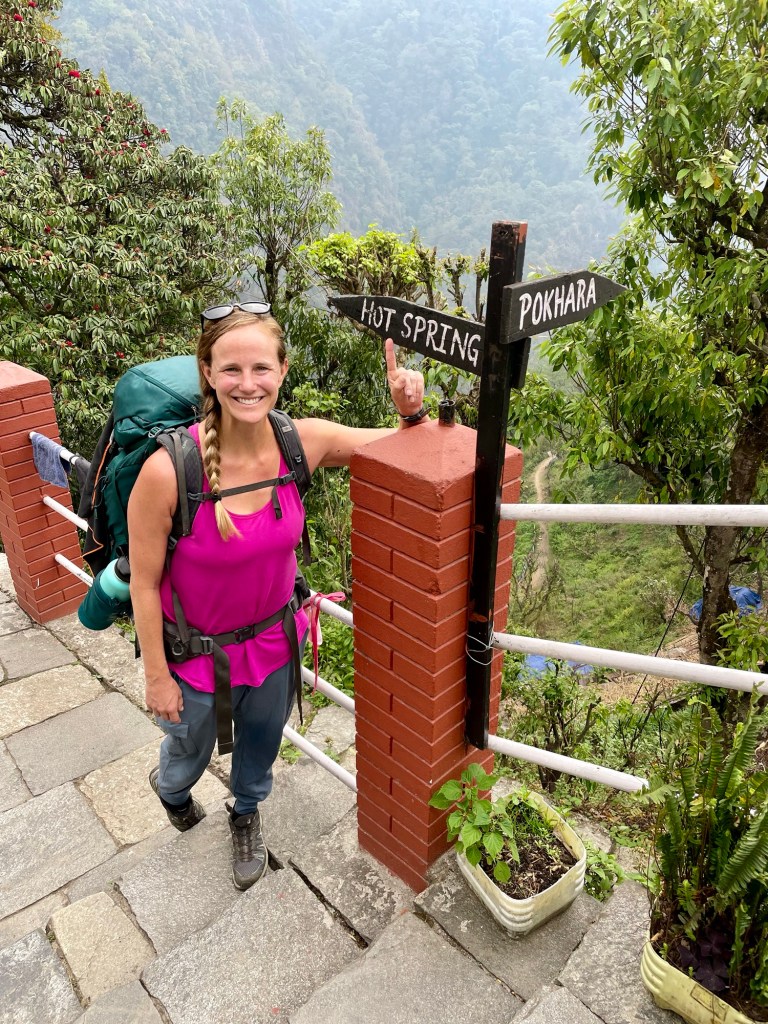
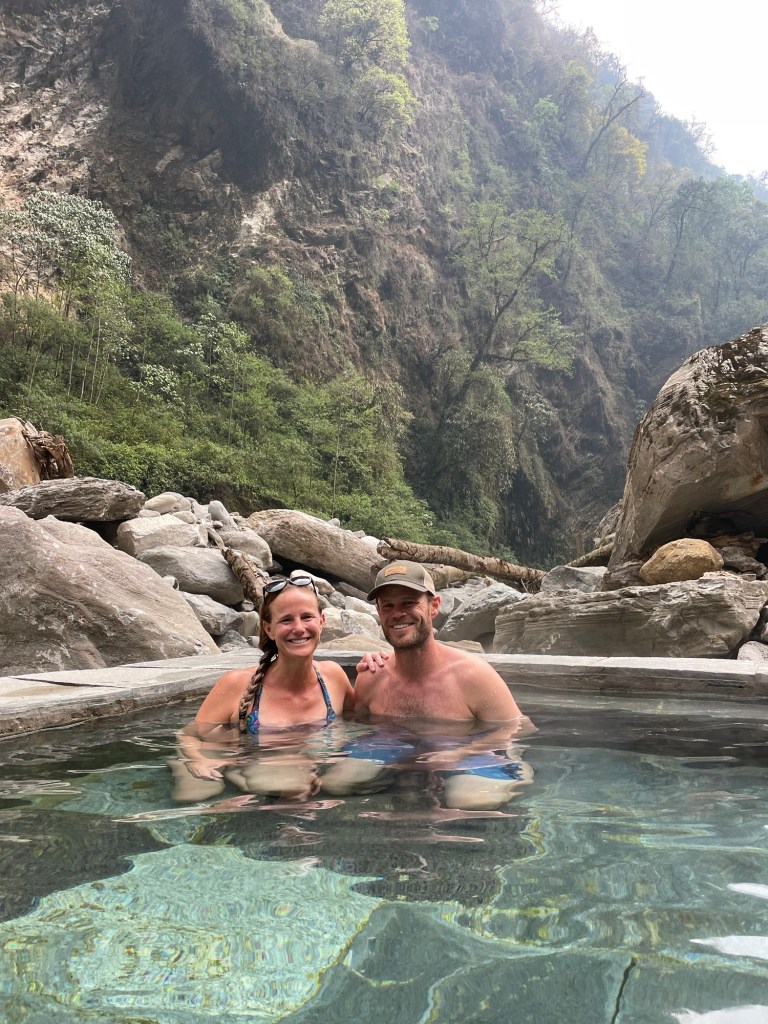
Unbeknownst to us at the time, a problem was arising as we were enjoying the hot springs so much that we inadvertently stayed a bit too long. After the pools, we needed to climb back up and out of the river valley, and across an amazing suspension bridge to reach the jeep stand to catch a shared jeep or bus out of the mountains and back to Pokhara. Since we didn’t come with a group tour or guide, we knew this part might be tricky since many jeeps are booked ahead of time. Our backup plan was that we were told there is a daily bus departing from this same spot at 3.00pm. Well, we reached the jeep stand at 2:30 and there was unfortunately no one else there to share a jeep, and we did not have enough cash on us to rent one outright on our own. As we inquired about our second option they told us that the bus was not departing from this small village today, but instead would be leaving from Ghandruk. So, we hightailed it out of there racing to hopefully catch the bus coming down that was now leaving from the neighboring village. Unfortunately for us, this was still five kilometers away and mostly uphill. Despite our very best efforts we soon saw that the bus had departed Ghandruk ten minutes early as we watched it come down the hill with no hope of reaching the junction point in the road by the time it would get there. In the end, we did make it to the junction by 3:00, but the bus was already five minutes past and we were left worn out, demoralized, and with no backup plan on how to get out of the mountains.
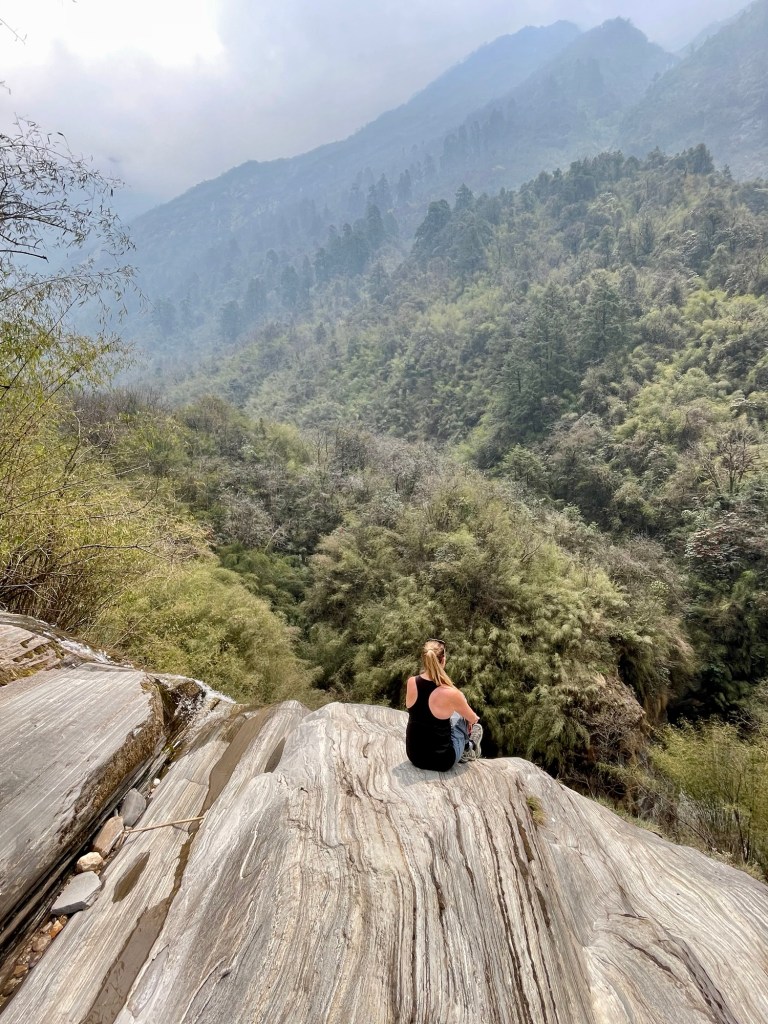
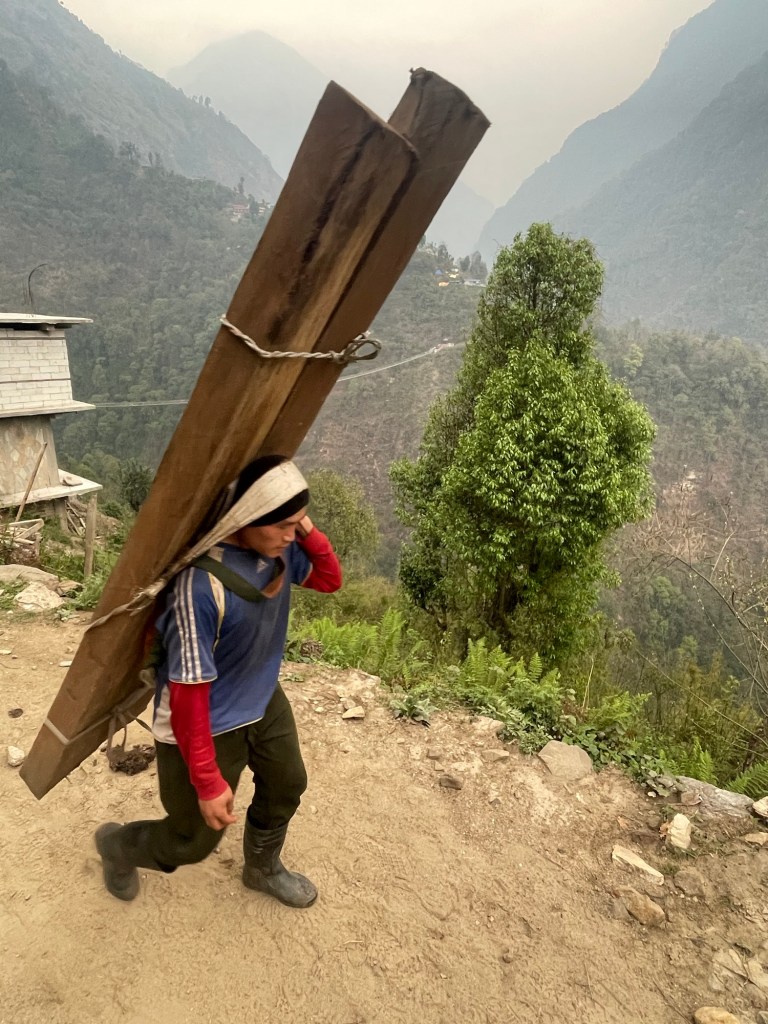
With no options left, we put one foot ahead of the other and kept walking down the dirt road hoping another bus or jeep would come by and have room to help us. We kept walking and walking and walking, yet there was absolutely no traffic going up or down at this point in the day. Finally, we met a local man who was born and raised in a village up here and he had also just missed the bus from Ghandruk. He was walking to the main highway to catch another bus into Pokhara, and he explained that he had walked this dirt road out of the mountains many times in his lifetime. He was very kind hearted encouraging us that it would only be another hour walk. I frustratingly thought okay, a bit long, but manageable. After one hour, I asked Nate how much further and he reluctantly told me that it was still another seven kilometers according to his GPS! I was devastated and physically at my breaking point. Luckily, after another three kilometers, a jeep finally passed by and for a small fee agreed to take the three of us to the highway. We were back in business, and with the help of our local friend, we negotiated with another jeep driver to transport us all the way back to Pokhara. I was beyond elated to have completed this epic unguided adventure! After a large dinner, our large hotel bed was calling and I slept like a baby that evening.
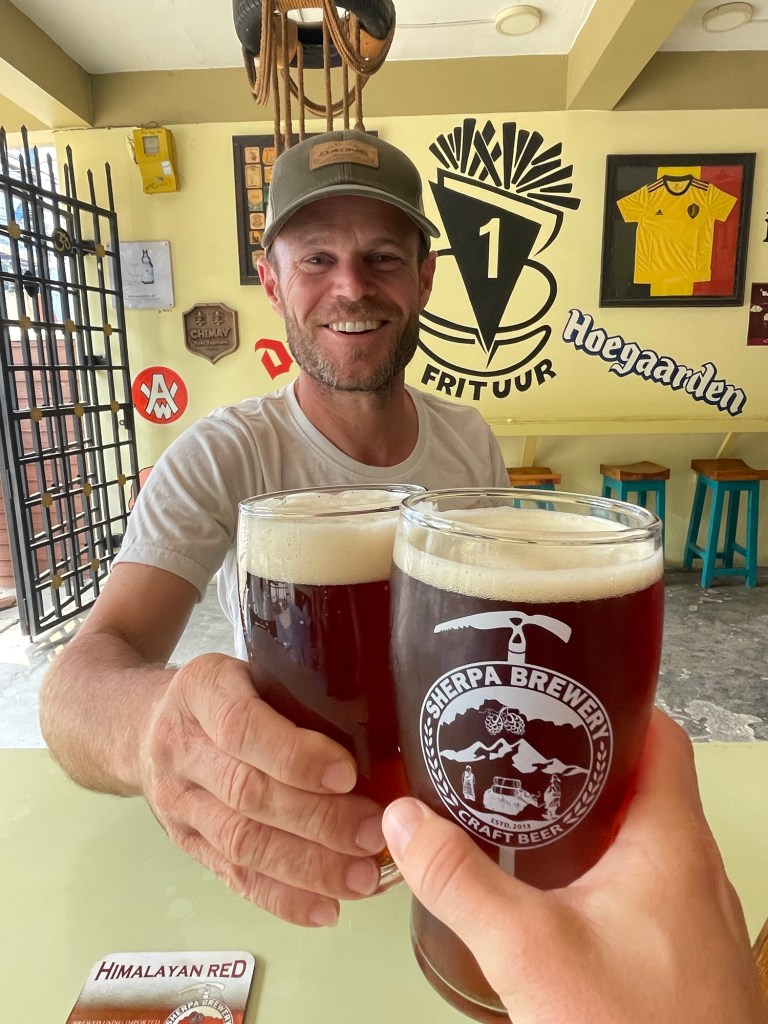
The following day we had a wonderful rest and recovery day in Pokhara where we wandered the town, enjoyed coffees, and did some shopping for our upcoming Everest and Three Passes trek. We found cute restaurants along the lake, there were tons of paddle boats, and even an old amusement park ironically named Disney World. Another fun find was a restaurant that was in an old plane. We had a good time people-watching, enjoying the local Nepalese culture and shopping. It was good to work out the legs and get them moving after the tough five days in the Annapurna region. Aside from the smog, Pokhara is an amazing small city that is full of life, shopping, and really great Nepalese and Western food!
 Teri and Nate's World Adventures