We departed Khiva, Uzbekistan, and made our way to the border to meet up with the guides from Saiga Tours and begin our five-day and four-night whirlwind adventure through the reclusive Republic of Turkmenistan. Before I discuss our adventure in this country, it is necessary for a quick explanation of how Turkmenistan has become such a unique country in the world. Similar to the other Central Asian countries we have visited, Turkmenistan was part of the Soviet Union until its collapse when it gained independence in 1991. At that time, a man named Saparmurat Niyazov was the leader of the communist party in Turkmenistan, and with the support of the ex-Soviet elites he subsequently became the first president in an uncontested election.

Throughout his tenure, which not surprisingly included several assassination attempts, Niyazov became increasingly paranoid and by most accounts a little bit crazy. Thanks to this paranoia and the strict government control he put in place, Turkmenistan still has the second highest incarceration rate per capita in the world, which, sad to say as an American, is second only to the US. However, unlike the drug and gang violence that is prevalent in my home country, Turkmenistan’s greatest offenders seem to be those who speak out against or are perceived as a threat to the state. During his tenure as President, he was one of the most totalitarian and despotic dictators in the world.

As Niyazov consolidated his power, he began to portray himself as a savior for the people of his country, and even a dogmatic-like figure similar only to what you might see in North Korea in current times. He even went as far as to anoint himself the title “Turkmenbashi” or “Leader of all Turkmen.” If that still seems normal, let’s quickly discuss his amazing literature. He takes credit for writing many books, but by far his most important and greatest writing is the Ruhnama, which he believed should replace all other religious texts and he mandated this must be taught in all schools. Students were required to memorize the book in order to graduate, and government employees were frequently tested on the writings during his reign. He even went as far as to build a National Mosque to worship his great literature with quotes from the Ruhnama carved into the walls opposed to the Qur’an, which is worshipped in every other mosque in the world. In addition, he ordered that his divine literature was to be displayed right next to the Qur’an at all other mosques throughout the country.

There is even an entire memorial park in the capital city of Ashgabat dedicated to his great book with a giant sculpture of the Ruhnama as the centerpiece. Not surprisingly, the teachings in his book are quite controversial including new words to describe the days of the week as well as each month, and some bizarre health and hygiene advice such as humans should learn from dogs (his favorite pet) and chew on bones to keep their teeth clean since dogs have such strong teeth. His interest in dogs led to an obsession with the Alabai breed, so he named it the National animal of Turkmenistan, which led to Alabai festivals, and statues of this dog throughout the country.

The list of idiosyncrasies about Turkmenbashi is seemingly endless, but one positive about his time as the President is that while most other post-Soviet Central Asian countries struggled with food shortages and violence, Turkmenistan has always been stable with plenty of food to go around. The greatest drawback for Turkmens is that the borders of the country have been, and remain to this day essentially closed off to the rest of the world. Citizens of Turkmenistan are not allowed to leave the country without express permission from the government and permission is not granted easily. Additionally, visas to enter the country are incredibly difficult to secure with one of the highest rejection rates of any country. It is arguably the most difficult visa to obtain in the world, and despite being the second largest country in Central Asia and the same size as California, fewer people visit Turkmenistan in a given year than visit Yellowstone National Park on a summer day.

When we started traveling this year, our hope was to go to Turkmenistan but throughout our travels, we heard that their land borders remained closed due to Covid. When approaching Osh, Kyrgyzstan we were provided with a bit of hope when we heard from some other travelers that they had now opened the land borders with Uzbekistan, but we needed a tourist visa obtained through a licensed Turkmenistan tour company. After some online research, we found Saiga Tours, and I am so glad that we did. They were prompt at answering our questions, and even though it was a bit last minute since it typically takes at least a month to obtain a visa, they said they would try their best and immediately went to work applying for an official letter of invitation (the first of several steps). They even personalized our tour for us, which allowed us to join one of their group tours for a couple of days, and then split off on our own for the final two days to help us keep costs down. I forgot to mention that the cost of traveling to this reclusive country is not cheap. The biggest drawback to this new plan was that were told that we most likely would not know if we were approved until just a couple of days before the start of the tour. Flash forward one month later, and just as we were told, it was two days before the start of the tour when we finally received an email with our formal letter of invitation to visit Turkmenistan for up to eight days. Our visas were going to come through and we going to experience Turkmenistan!! We now needed the USD and hence, the shady back door money exchange described in our previous post was essential.
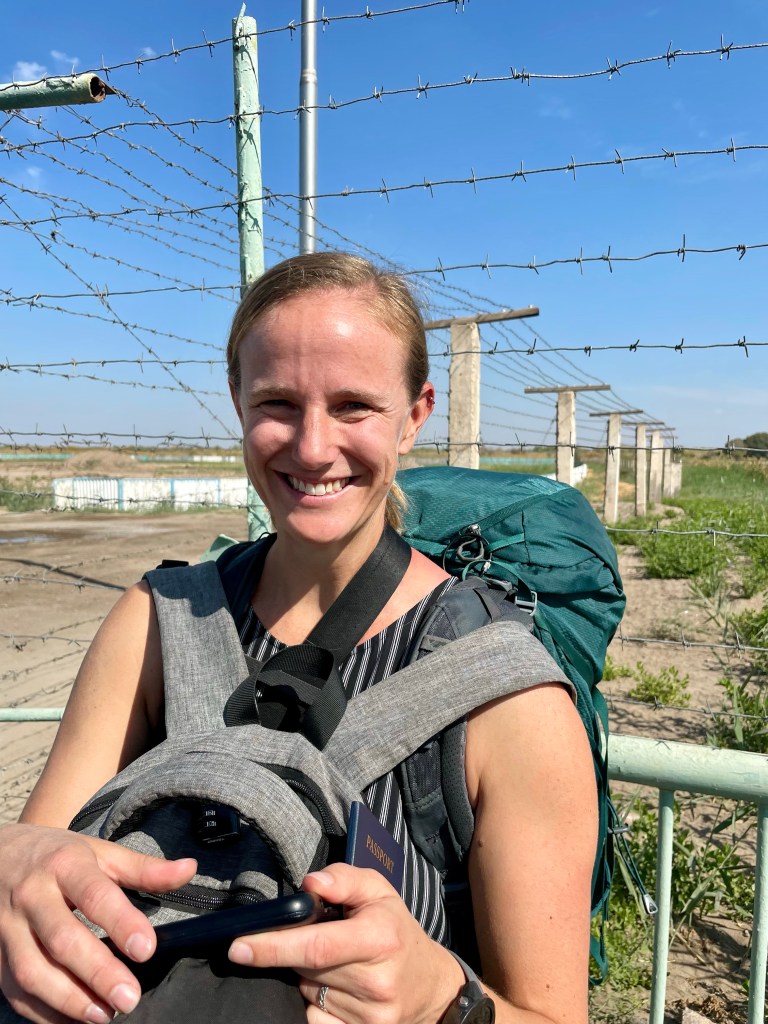
At the border, we met up with the owners of Saiga Tours, Ben and Eilidh, and a couple of other foreigners who had been on a tour of all of Central Asia with them. Together we started our border crossing, which may be my longest border crossing to date. The first order of business after stamping out of Uzbekistan was a COVID PCR test, which was a very questionable procedure as I think they just throw away the results and sign off that everyone comes back negative. Turkmenistan was the second to last country in the world to reopen their border with only North Korea remaining closed longer, and this PCR test seemed to be more of about an additional fee, or propaganda for their citizens to see how the government was working hard to keep Turkmen safe from covid as they began to reopen the border to foreigners. Fun fact, Turkmenistan still to this day has never recorded a positive COVID test… After the COVID test, we waited while Eilidh fought her way through crowds of locals to get our visas sorted. We were almost to the point where we could cross, but then they decided it was lunch hour, and instead of taking lunch in shifts, they just shut down the whole border crossing for one hour while the staff ate. Finally, after the lunch break and around five hours of waiting we received our visa stamps and entered the country!


Nate and I left the group at this point because we wanted to go to a small town called Konye-Urgench with some impressive mausoleums and historical ruins, but the rest of the group was not up for the ninety-minute drive. Our tour company arranged a private driver to take us north to see the ruins. Although they are well north of where we crossed into the country, these ruins sit only a few miles from the Uzbekistan border and were built by the same civilization that built Khiva. In fact, the culture, food, and language of the people here on the northern border of Turkmenistan are exactly the same as those in Khiva, and this region was only divided when borders were drawn up at the end of the USSR, which sadly separated many friends and families from each other.

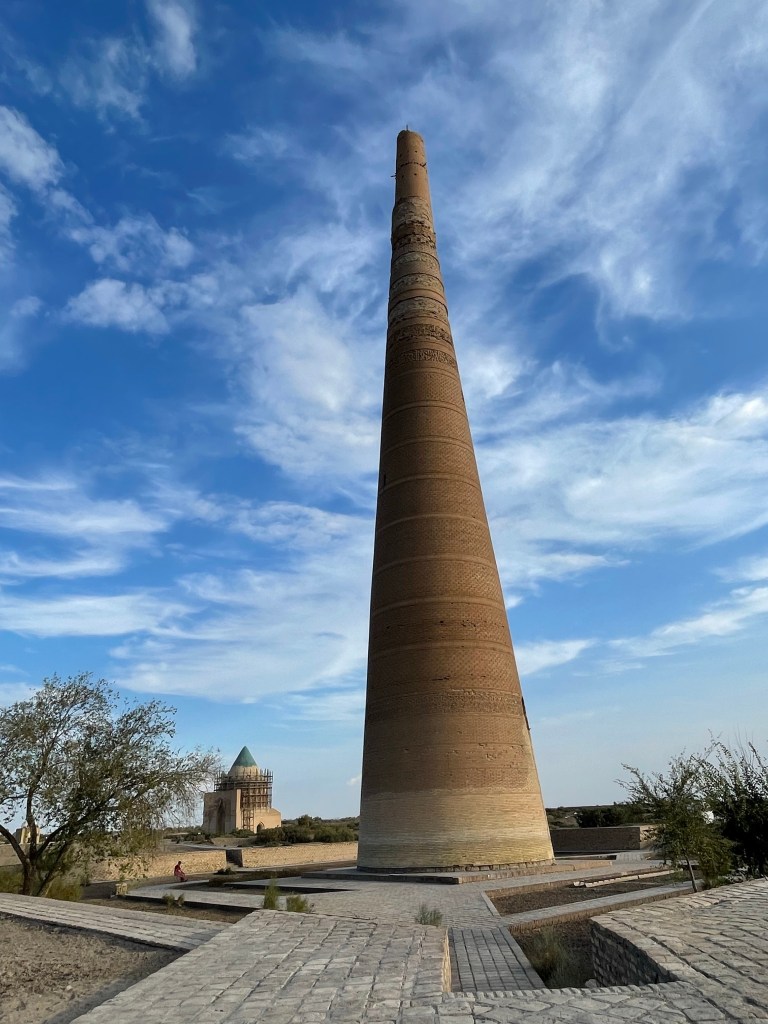


Konye-Urgench is by all means what I believe an ancient city in this region would have looked like before it was restored. The buildings were a bit run down, but in a more natural state, we found them almost more beautiful. On the large minaret, you can still see damage from Genghis Khan when he ransacked the city. In Turkmenistan, tourists legally have to be chaperoned at all times, and in Konye-Urgench we enjoyed a bit more freedom to move about on our own because our driver stayed in the car and left us to explore the ruins unchaperoned. We found that on our own the local people were willing to approach and talk to us a bit more. I felt quite famous as we took a LOT of selfies with local kids and teenagers. It was interesting to see kids quite happy and enjoying themselves in a country that we anticipated would be incredibly strict and solemn.

After a couple hours of exploring and picture-taking our driver took us back to the train station in Dashoguz, the regional capital where we took an overnight train south to Ashgabat, the national capital. The rest of the group took a flight that evening, but since we were approved last minute, the flight was fully booked. The flight would have been easier, however, we did not mind the train. This turned out to be another incredibly unique opportunity to meet some local Turkmen people and we turned out to have a great time!
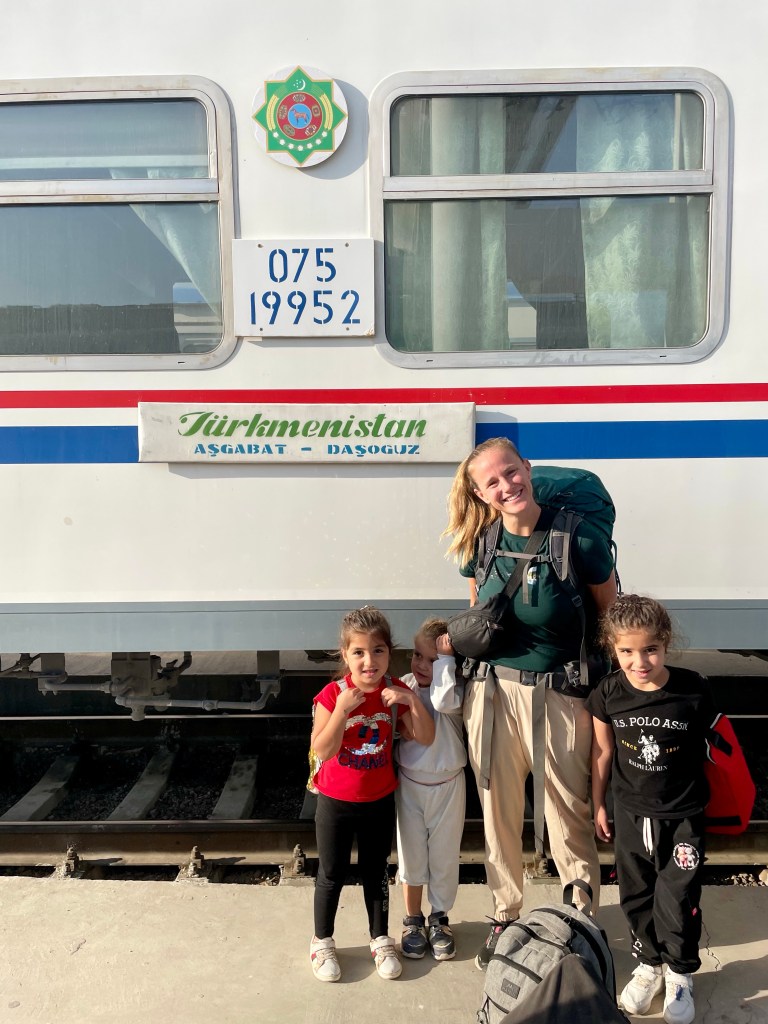
Unlike the last overnight train in Uzbekistan, first class was sold out this time, so we were in a four-person sleeper. We were joined by an eighteen-year-old boy (and his extremely inquisitive friend for most of the evening) as well as a thirty-five-year-old man whose wife works as an English teacher. For most of the night, we passed around our phones using the translate app to communicate, and we learned a lot about Turkmenistan while they learned a lot about the outside world. It turned out the two boys had just graduated High School and were going to Ashgabat in hopes of securing visas to study in Kazakstan. To give you an idea of how closed-off Turkmenistan is, the two boys told us we were the first foreigners that they had ever met. The other gentleman called his wife and we chatted to her on the phone in English for a little while. We saw videos of his wife singing traditional Turkmen songs and watched videos of the two boys dancing and celebrating their graduation. Even though the internet is restricted in the country and VPNs are illegal, it seems that everyone has a way to connect with social media. We found it very surreal how curious and interested everyone was, and still cannot fully grasp that we were literally the first foreigners that nearly everyone on the train had seen in many years due to COVID. Everyone we met on our first day here seemed happy, but also yearning to know what life outside of the country is like.

Upon our arrival in Ashgabat the following morning we were picked up at the train station by a driver, quickly checked into our hotel, and were off to meet up with the rest of the group for a day tour of Ashgabat. Ashgabat is a beautiful and sparkling clean capital city, but Turkmenistan is famous for its bizarreness and there are certainly some interesting things going on here. The first thing that you cannot help but notice is the obsession with white. Only white, light grey and gold cars are allowed to drive inside the city limits, and it is compulsory that your car must be clean. White is a sacred color in Turkmenistan because to them it is the equivalent of gold.

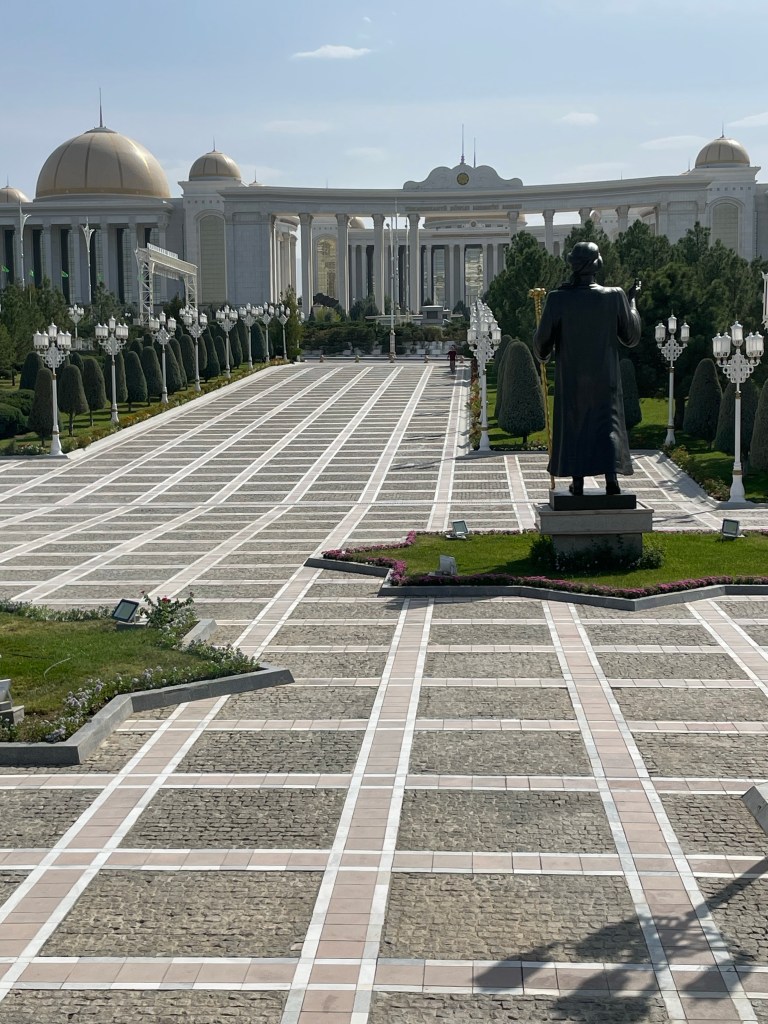
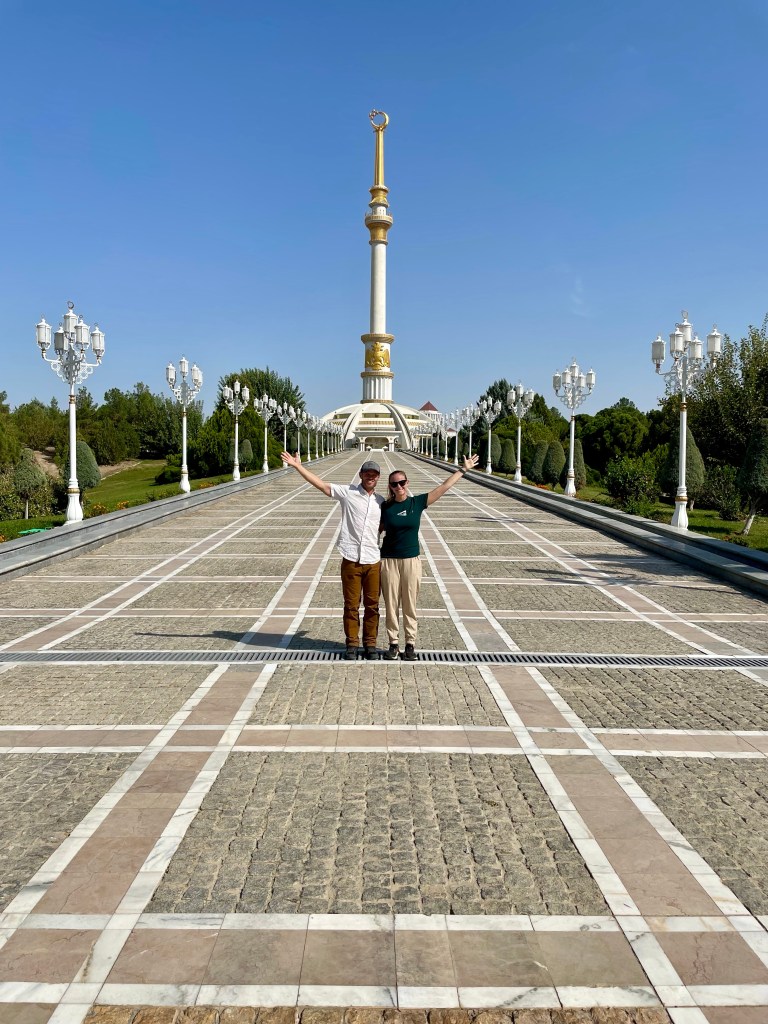
The capital is divided into the old city and the new city. The new city is essentially a vast open space made up of parks (where copious amounts of water are used to keep pine trees growing in the desert), thousands of street lamps, and giant immaculately well-kept monuments. It is a beautiful place, but it is very quiet here with almost no one other than the gardeners and cleaners in sight. Ashgabat hearkens back to when we visited Nay Pyi Taw, Myanmar where the theory was to build it and they will come, but no one ever seemed to come. It was quite a surreal and quiet experience in the new city since we had all of these extraordinary marble monuments and beautiful parks to ourselves.
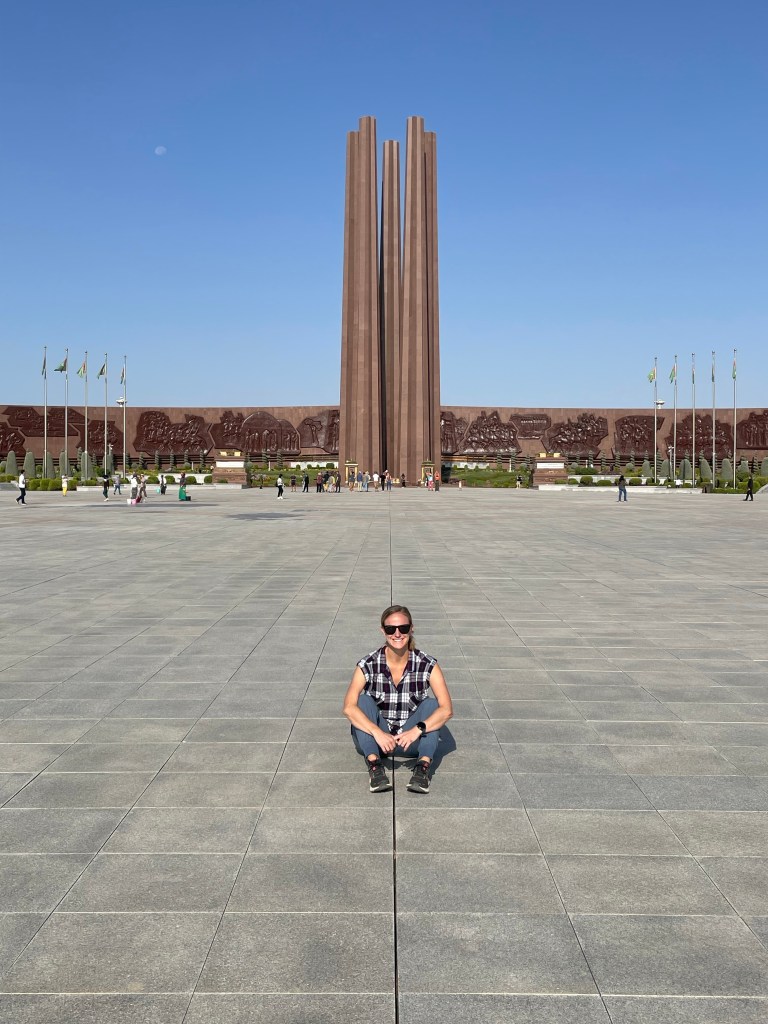


Here, we also encountered the world’s largest indoor Ferris wheel. However, I do think this title is a bit misleading. While the Ferris wheel is covered by a roof, it is not fully enclosed. When we arrived the Ferris wheel was not running, but after paying roughly fifty cents each they turned it on for us to ride. There is even a presidential car on the Ferris wheel reserved for if the president ever comes for a ride and has its own couch and TV inside.

From the Ferris wheel, you can see government buildings, however, we were instructed not to take pictures of government buildings too closely or we could potentially get in trouble. The government buildings are interesting because the design of many of the buildings relates to the purpose. For instance, the Department of Education is in the shape of an open book, and the National Institute of Dentistry is in the shape of a tooth.


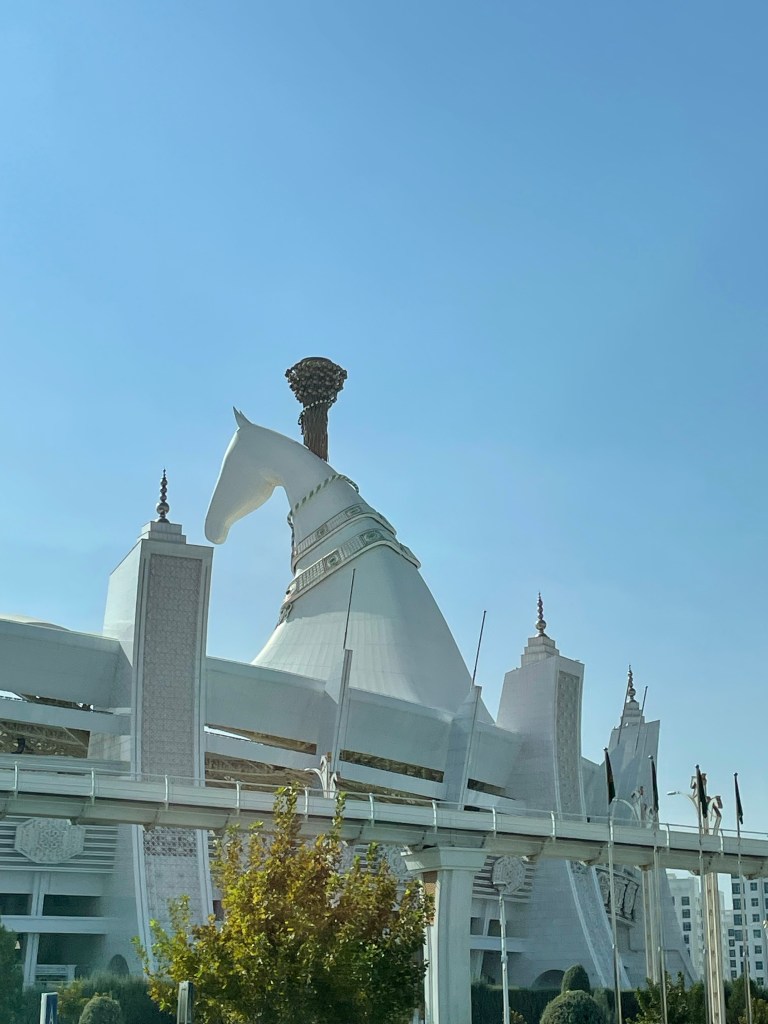
We passed by the world’s largest thermometer, as well as a beautiful sports complex that was built for the 2017 Asian Indoor and Martial Arts games. Rumor has it that they spent more on building facilities for these games than most countries spend when hosting the Olympics. They built a giant stadium in the shape of a horse and a monorail system exclusively for the athletes and press to get around, which has apparently never been used again.
At the end of the day’s tour, we went by the Presidential office and Parliament where pictures are absolutely forbidden, and then stopped off at a University bookstore where Turkmenbashi’s books, as well as those written by his successor, the second President, fill up nearly the entire book store. It is one of many eccentric details from our day tour in the capital that make this city and country scratch your head. We were finally dropped off at the market where the big thing for tourists to buy is the 2017 tracksuits that were given to the athletes for the Asian indoor games, which apparently every Turkmen owns. I love that they just sell these national tracksuits at most clothing stores and nearly everyone in our group bought at least one bright green tracksuit as a souvenir. On the walk back to the hotel, we found a small store selling only draft beer. This was an opportunity that we could not pass up, however, it felt quite weird to be able to sit outside on a street bench drinking a draft beer in one of the strictest countries I have ever visited.

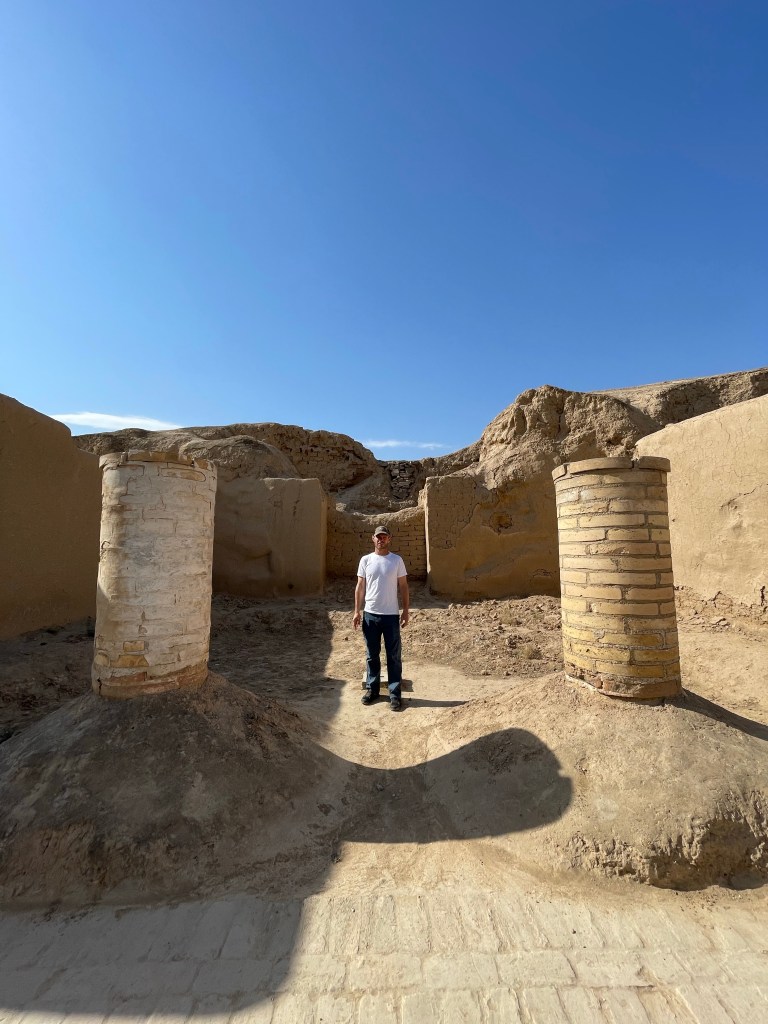
The following day we woke up and were driven on a bus just outside of the capital to the Old Nisa ruins. These ruins date back to the 3rd century BC and it is believed that it was once a palace for Parthian Empire. They are slowly renovating the site and much remains buried in centuries of dirt and mud, but it is amazing to see the mud walls that are exposed and columns that date back to ancient times.

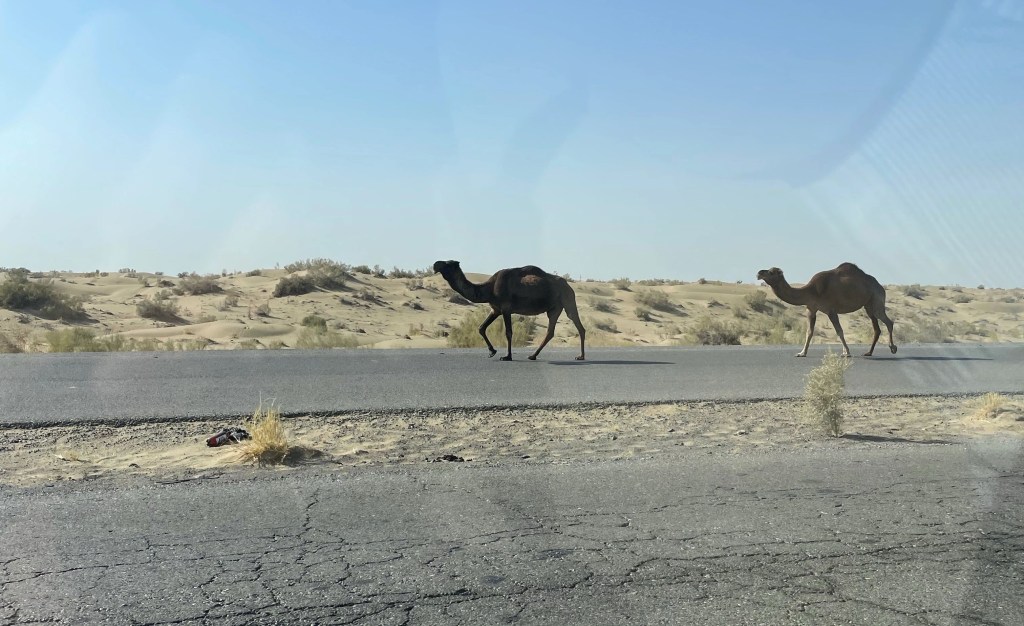
On the way back into the city we drove past the infamous Turkmenbashi Mosque worshipping his great literary work the Ruhnama, but unfortunately, the monument and final resting place of the country’s founder was closed for renovations so we could not enter. The tour bus then took us to a high-end mall where we enjoyed lunch, and picked up supplies and food for dinner that evening before departing for the famous Gates of Hell. In order to travel out into the desert to the Darvaza Gas Crater we had to leave the bus behind and take SUVs. Our 4×4 drivers picked us up after lunch at the mall where we had to split into groups of four because the large tour bus could not travel on the roads that we were about to encounter. We drove north out of the city where we encountered many groups of beautiful one-humped camels marching their way through the desert.
After a couple hours, we took a turn off the road and began to drive straight through the sandy desert until we arrived at the most famous tourist destination in Turkmenistan, the Darvaza Gas Crater, more commonly known as the Gates of Hell. We arrived at the crater just before sunset, which was the plan, and turned out to be a perfect time to see the massive crater of fire in the middle of the desert for the first time. We all were ecstatic to finally see this amazing wonder with our own eyes and were drawn in by the beauty of the giant fire. We could feel the heat emanating from the crater right away and knew we were in for a great night!


When discussing the crater the first question is naturally how did this form. As with the Aral Sea, this is another story of the Soviets messing with nature. A little over fifty years ago the Soviets were drilling extensively in this area for natural gas. After successfully drilling here they were in the process of putting in the well and pipelines when a sinkhole opened up and the entire area collapsed. The sinkhole meant that all the natural gas was no longer contained, and was now leaking into the environment. After a great deal of contemplating the Soviet scientists and engineer’s solution was to set the crater on fire to burn off the gas with the belief that it would burn off in a few days, or weeks. It turns out that this solution didn’t work out as planned, and the crater has now been on fire for 52 years. It really is one of the most spectacular sights I have seen in my life.

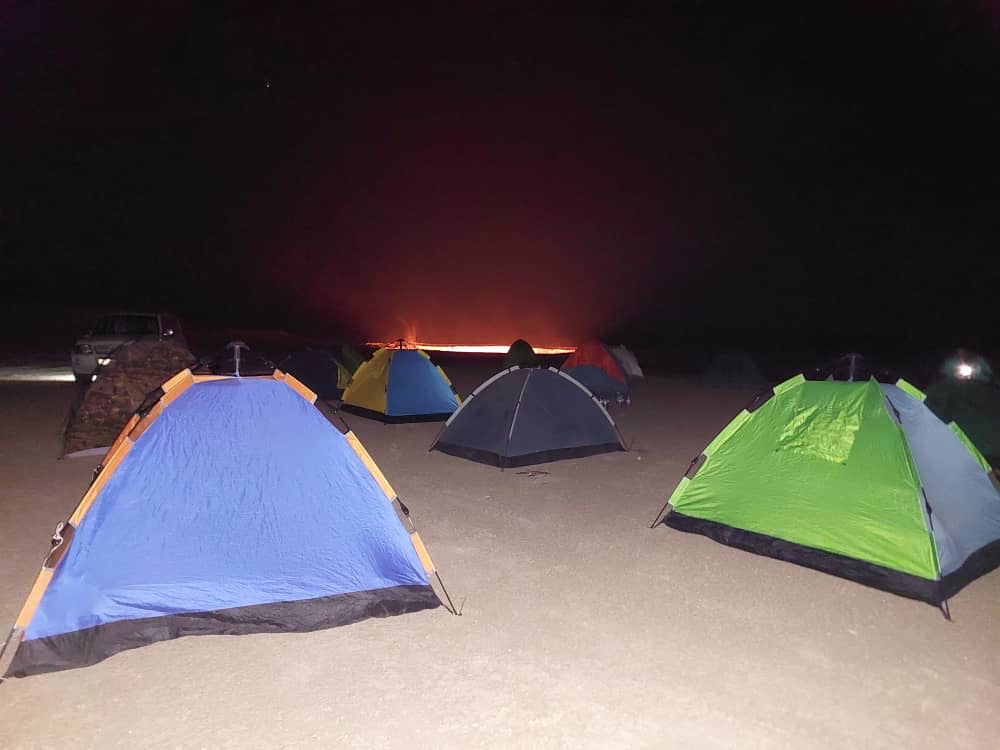
Our tour was timed so that we saw the crater at the end of the day, at sunset, and then we camped nearby to enjoy the fire throughout the night. While we were taking in the sunset, our drivers set up the campsite, tents, and sleeping mats for us. There was also a nice hill nearby to take in the crater from above for a larger scope of the desert. Nate and I returned to grab our food and made a little picnic right next to the crater for a once-in-a-lifetime dining experience. We hung out with our tour group until a bit past midnight enjoying the most spectacular campfire you can imagine being mesmerized by the flames and giant crater that we stood above, and taking pictures. It was truly a night to be remembered.


In the morning, we awoke early to take in the sunrise over the crater. The first sight I took in when leaving the tent was camels running through the desert which was incredible to see. We put on our lovely green tracksuits for some great pictures to commemorate this surreal occasion. While sunset was a bit of a disappointment, sunrise was spectacular with the changes in the colors of the sky. I was sad when we were told it was time to leave.


After driving back to Ashgabat, Nate and I had only one hour to say goodbye to our tour group, grab some lunch at a nearby cafe, and head to the train station to depart east to a city called Mary where we stayed that evening. This was the point in our Turkmenistan trip where we were leaving the group and going off on our own while working our way back into Uzbekistan. Due to our upcoming flight schedule and budget for this trip, we were not able to stay with the tour for the entire ten days in Turkmenistan, but we would love to come back to see and experience more of this unique country in the future.

We once again enjoyed a unique experience with local Turkmen on the train to Mary and received many shocked looks from the locals when we arrived at the train station in this smaller city at nearly midnight that evening. There is a national 10:00pm curfew in Turkmenistan, so everyone at the train station had to have special permission to be out past curfew and the police were outside trying to enforce this. My guess is that they do not see many foreigners in Mary, particularly at the train station, but luckily we had a driver waiting for us as we got off the train and he quickly escorted us off to one of the nicest hotels in Mary where we stayed the night.


The hotel accommodations in Turkmenistan are all very nice, but they are quite expensive and with such few tourists feels eerily quiet and empty. Our final site to see that next day was just outside of Mary. The ancient city of Merv was a very important stop on the Silk Road and was inhabited from the 3rd millennium BC to the 18th Century AD. This city had several different names over the years, and many civilizations held the city as sacred and prospered here due to the strategic location in the heart of the Karakum desert nourished by the rivers flowing out of the Karakoram mountains further east. Our guide informed us that at one point it is believed that Merv was the most populated city in the world. The ruins are in various states of disrepair depending on the age of each site, but the history here is remarkable just the same.

After leaving Merv, we dropped off our English-speaking guide for the ancient city tour and our driver took us three hours north through the desert to the border. We stopped in the border city of Turkmenabat at one last amazing local restaurant with our driver before he dropped us off at the Uzbekistan border where we enjoyed yet another lengthy and chaotic crossing. Turkmenistan is among the most uniquely interesting and perplexing places we have ever visited. It is a country with great people, terrific food, and fantastic crazy sites to see. I hope that the borders become more accessible for both sides and that they sort out the chaos and delays at the crossings before we ever come back!
Once we successfully crossed back into Uzbekistan we hopped on one more night train to Samarkand where we had to wake up early for a flight that next morning to Greece!
 Teri and Nate's World Adventures
Thanks for the intriguing post, I shared it with my EAP students this morning. You’re still an inspiring teacher!
LikeLike
Yay!! That’s so exciting! Thanks for reading!
LikeLike